Gemini 4 Argon is now available in ThinkReview

Gemini 4 Argon is now available in ThinkReview
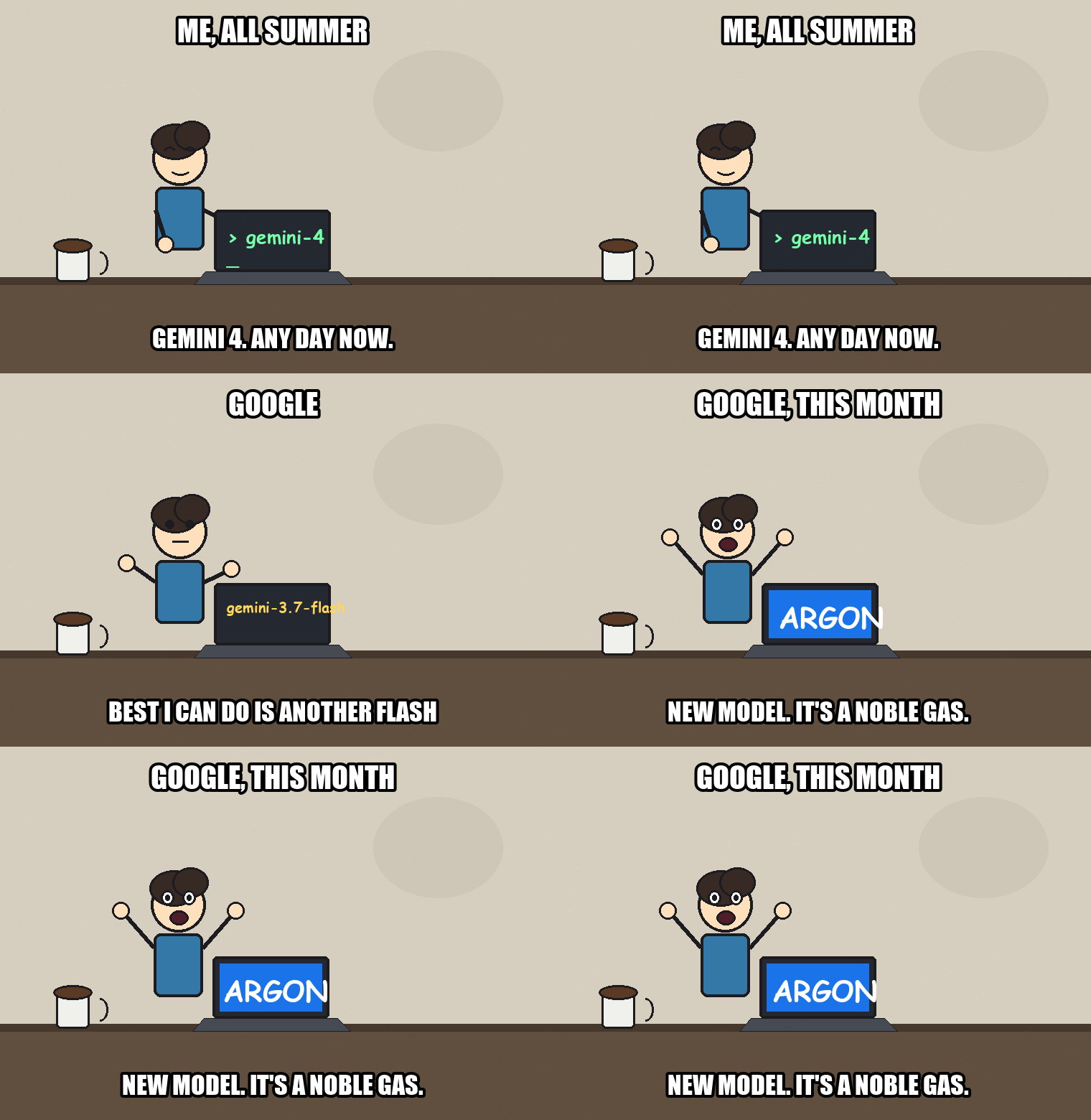
I refreshed the Gemini blog all summer. They answered with a noble gas.
We're excited to announce that Gemini 4 Argon is now available in ThinkReview. On October 13, Google opened Gemini 4 Argon to developers on the paid Gemini API, two weeks after the September 30 announcement. Koray Kavukcuoglu, SVP of Google DeepMind, put it this way:
Gemini 4 Argon delivers frontier performance to help in complex workflows across real-world software engineering, enterprise knowledge work like legal and finance, and cybersecurity defense.
You can use it today for AI-powered code reviews on GitHub, GitLab, Azure DevOps, and Bitbucket. The model id is gemini-4-argon.
What Google shipped
Argon is the flagship after a long run of Flash releases. Google calls it the most capable Gemini, for complex coding, agents, math, and science. Input, thinking, and output share one window of 1,048,576 tokens, and a response can run past the old 64K cap, up to 1M tokens minus the input.
From the launch and the developer guide:
- Introductory price through November 30, 2026 — $2 per million input tokens and $10 per million output tokens, thinking tokens included. On December 1 that becomes $4 / $20. Implicit caching takes cached input down 95%, to $0.10, then $0.20. Paid tier only.
- Tunable thinking —
low,medium(the default), andhigh. Google recommends medium for most tasks, including complex code and agents, and high when the problem is genuinely hard. - DeepSWE v1.1 at 77.9% — ahead of GPT-6 Astra at 74.1%, Claude Opus 5.5 at 74.2%, and Claude Fable 5.1 at 67.4%.
- Knowledge-work leads — Vals Index 68.9%, AutomationBench 51.3%, Vals Finance Agent v2 65.4%.
- The long window holds — GraphWalks BFS F1 of 99.7% up to 128k tokens, and 84.2% from 256k to 1M.
Google's line on the coding number:
It sets a new state of the art on DeepSWE v1.1 (77.9%), which measures a model's performance in real-world long-horizon software engineering tasks.
The intro rate matches Claude Sonnet 5.5 at $2 / $10. After November 30 it matches Opus 5.5 at $4 / $20. Grok 4.7 stays at $2 / $6. Gemini 3.8 Flash is still the smaller bill when the diff is ordinary.
The benchmarks, in charts
These figures are from Google's October 2026 model card, next to GPT-6 Astra, Claude Fable 5.1, and Claude Opus 5.5. Read one bench at a time. A lead on DeepSWE is one row.
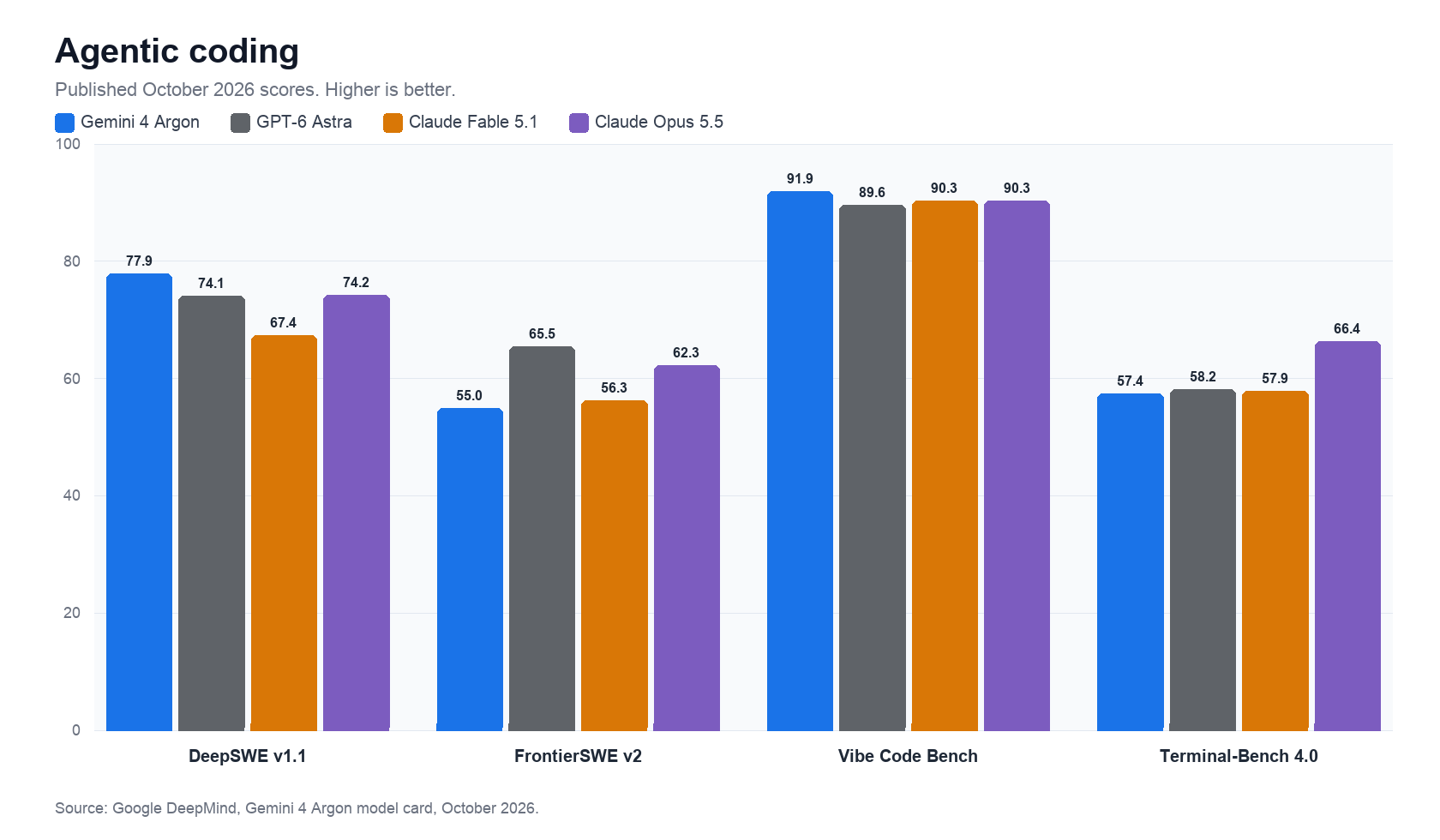
On agentic coding, Argon leads DeepSWE v1.1 and Vibe Code Bench. Astra leads FrontierSWE v2. Opus 5.5 leads Terminal-Bench 4.0.
Source: Gemini 4 Argon model card, results as of October 2026. Methodology: Gemini 4 Argon evals.
DeepSWE v1.1 is long-horizon software engineering, solved end to end. Argon at 77.9% is about four points over Astra and Opus 5.5, and about ten over Fable 5.1. Vibe Code Bench is tighter: 91.9%, against 90.3% and 89.6%.
FrontierSWE v2 asks whether the change would merge. Astra 65.5%, Opus 5.5 62.3%, Fable 5.1 56.3%, Argon 55.0%. Remember that row before Argon becomes the default for "would I merge this." Terminal-Bench 4.0 clusters around 57–58%, and Opus 5.5 leads it at 66.4%.
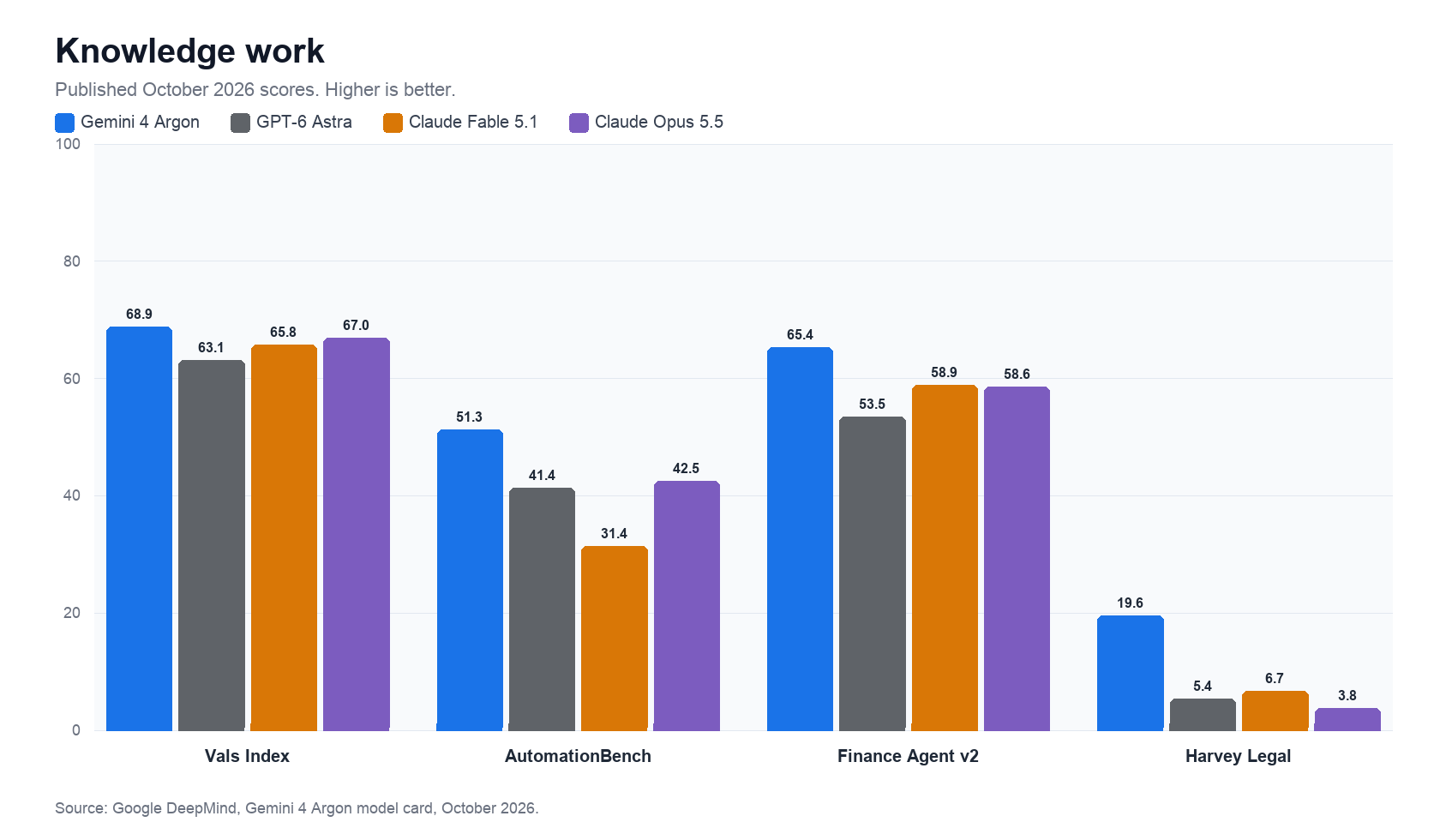
Knowledge work is more one-sided. Argon leads every row Google published in that block.
Source: Gemini 4 Argon, October 2026.
Vals Index weights finance, coding, legal, and tax by U.S. GDP. Argon 68.9%, then Opus 5.5 67.0%, Fable 5.1 65.8%, Astra 63.1%. AutomationBench, Zapier's end-to-end business bench, is 51.3% against a pack in the 30s and 40s. Harvey's Legal Agent Benchmark is a low score and a wide gap: 19.6%, then 6.7%, 5.4%, and 3.8%.
Long context is the chart that maps onto a large pull request. GraphWalks asks the model to walk a graph inside a long document. Argon's lead widens as the window grows.
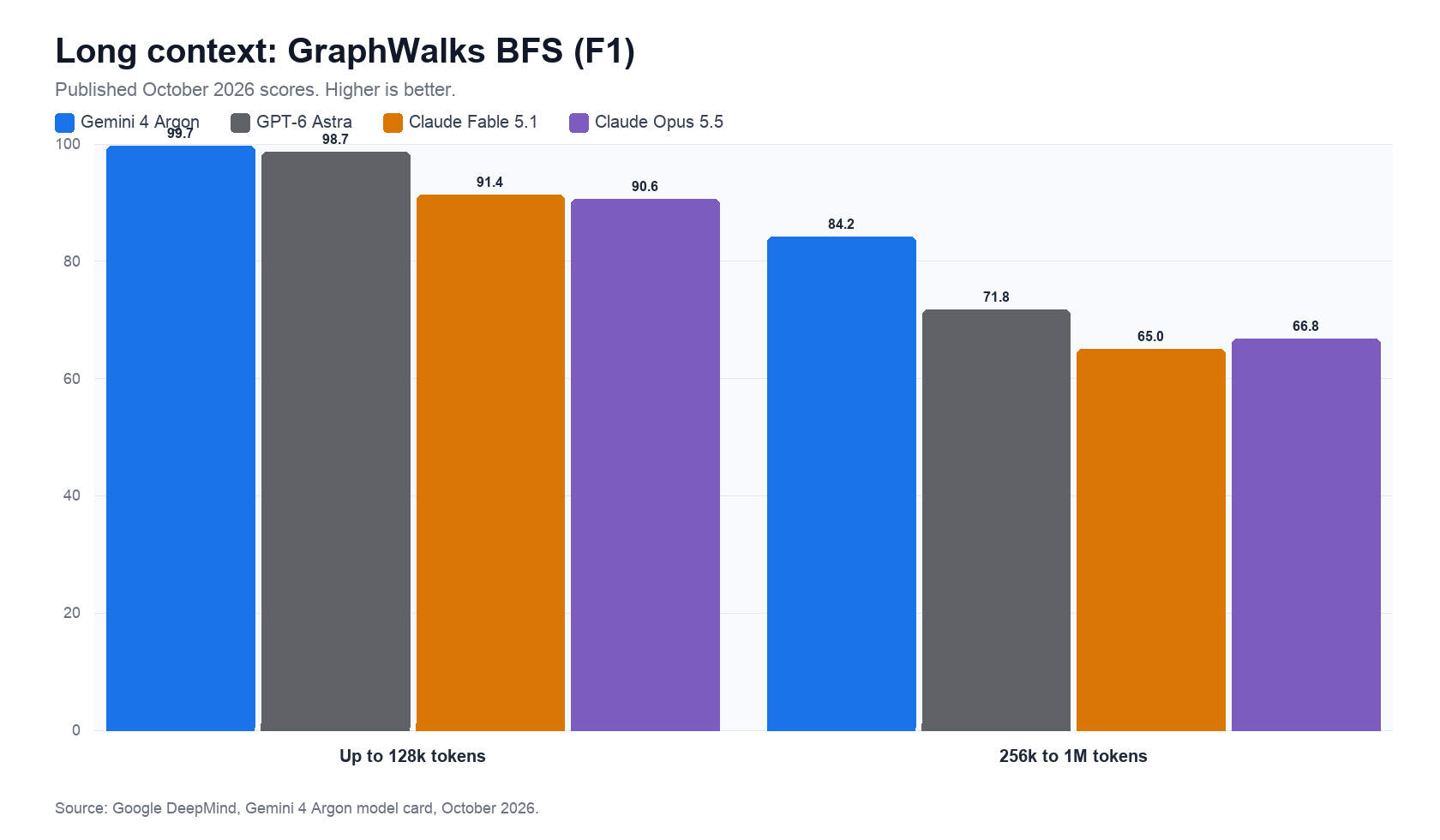
Source: Gemini 4 Argon, October 2026.
Up to 128k tokens, Argon is 99.7% and Astra 98.7%. From 256k to 1M, Argon stays at 84.2% while Astra falls to 71.8%, Opus 5.5 to 66.8%, and Fable 5.1 to 65.0%. That is the gap when a review has to hold a service, its callers, and the tests in one pass.
Same card, two more rows. CWE-bench v1 ties Argon and Astra at 68.0% on vulnerability remediation. LVBench is 91.7% for Argon.
What this means for code review
A hard pull request is a change that spans files, a trace that outgrows the hunk, and a comment someone will actually use.
- Long-horizon coding is the lead. DeepSWE at 77.9% is the public number closest to "read the change, follow it, finish the note."
- The window is the other half. GraphWalks still at 84.2% past 256k is how a review keeps the surrounding service in view. Pair it with repository-level context when the bug lives outside the diff.
- Check the rows Argon trails. FrontierSWE v2 at 55.0% and Terminal-Bench 4.0 at 57.4%. For a merge call or a long shell trace, run Opus 5.5 or Astra on the same diff before you switch the default.
Yashodha Bhavnani, VP of AI Products at Box:
Gemini 4 Argon is at the frontier of enterprise knowledge work, achieving a 14% improvement in accuracy compared to Gemini 3.1 Pro. In Box's evaluation, Argon connected evidence across the full set of documents, including details embedded in figures, and carried multi-step analyses through to complete answers.
Gopal Srinivasan, Global AI and Data Lead at Deloitte, on long-running work:
Early impressions from Gemini 4 are very strong: for long-running tasks across these workflows, it completed successfully 100% of the time in our evals, maintaining context and running through multiple tools across impressive spans.
Keep Gemini 3.8 Flash when you want the workhorse price. Use Argon when the diff is worth flagship reasoning. The intro rate ends November 30.
How to use Gemini 4 Argon in ThinkReview
- Open ThinkReview settings — Click the extension icon and go to Settings or Model selection.
- Choose Gemini 4 Argon — Select it from the model dropdown for your reviews.
- Run a review — Open any pull request or merge request and start ThinkReview with your chosen model.
Manage your catalog in Model Selection on the ThinkReview portal.
Where it works
Same as always: GitHub, GitLab, Azure DevOps, and Bitbucket Cloud. One extension, one workflow — now with Google's Gemini 4 Argon.
If you try Gemini 4 Argon on real pull requests and have feedback, we'd love to hear it — open an issue on GitHub or reach out via thinkreview.dev.
Ready to try Gemini 4 Argon on your next PR? Install ThinkReview or manage your models in the portal.
Quotes, prices, and benchmark figures reference Google's Gemini 4 Argon announcement (September 30, 2026), the developer availability post (October 13, 2026), and the Gemini 4 Argon model card.