Why Google shipped Gemini Decision 1
Jev opened the decision-model category on September 15. Google shipped Gemini Decision 1 eight weeks later. The request board shows who got the traffic.


Eight weeks after Jev, Google built a decision model for jobs Flash was already doing. The traffic stayed with the first model and the cheap one.
A decision model returns a probability for an answer you already listed. On OpenRouter that category is now a traffic chart, and Gemini Decision 1 is thirteenth on it.
The board
Jev 1.13 and Jev 1.14, both from TypeSafe, sit at 861 million and 666 million requests. Together that is about 1.5 billion calls. Perplexity's Decider is the other family in nine figures: Decider V1.2 at 220 million, and the free Decider V1.3 at 150 million, up 158%.
Gemini Decision 1, two weeks after its November 11 launch, is at 18.3 million requests and down 20%. Microsoft-Decision-1.1, generally available on November 17, is at 23.3 million and up more than 999%. GPT-6 Luna on OpenAI's Decisions API is ninth, at 26.2 million, down 4%. Drex, Liquid's d1 line, and Cloudflare Clef fill the middle, from about 45 million requests down into the single-digit millions.
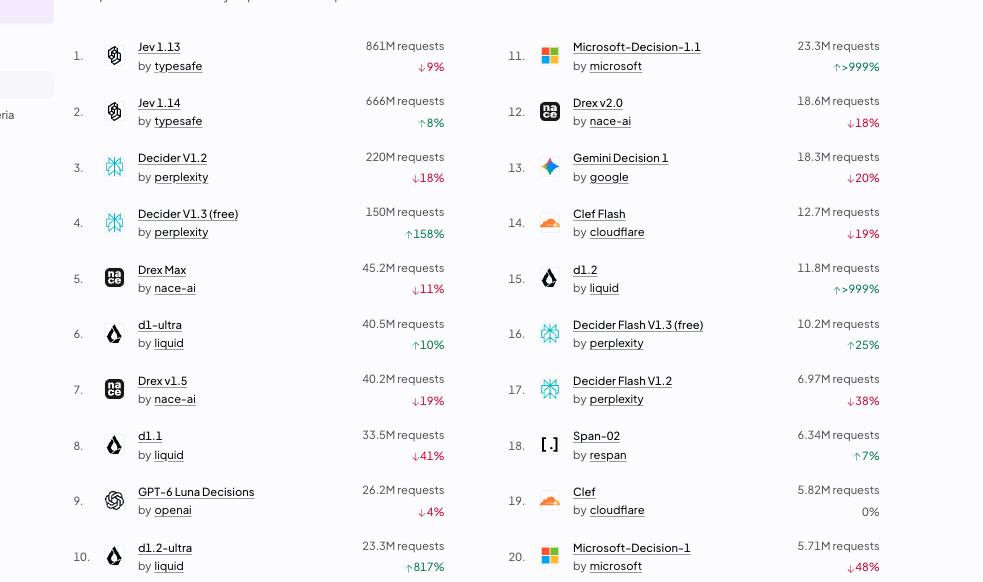
Source: OpenRouter decision-model rankings. Jev leads. Gemini Decision 1 is 13th.
Jev 1.13 still leads 1.14, which shipped on October 14 and is the line moving up (8%). Teams pin a version once a confidence threshold is tuned, because a new model moves the false-positive rate.
What these models return
You send state (a ticket, a diff, a screenshot, a call) and a list of questions. The model scores every question in one pass and hands back numbers. There is no paragraph to parse, and output tokens are free because none are generated.
Three question types show up on almost every API:
- Yes/no. TypeSafe and Google call it
noul. OpenAI calls itpredicate. You get a probability from 0 to 1. - Choice. One label from options you supplied, plus a probability for each.
- Score. A point on an ordered rubric, as a probability-weighted position.
Jev 1.14 added box, a single bounding box. Perplexity's Decider v1.3 added locate, character spans in the text. The schema is fixed, so the model stays inside the options. The probability can still be wrong. Calibration, how close "0.9" is to "right 90% of the time," is the actual fight.
Diogo Almeida named the class System One, after the fast thinking in Kahneman's Thinking, Fast and Slow, and named the model Jev after William Stanley Jevons. The Jevons bet is the price: cheaper decisions should raise demand.
Jev, September 15
Almeida helped build RLHF and the research behind ChatGPT at OpenAI, then left in 2024 to start TypeSafe. The company stayed in stealth for two years. On September 15, 2026 it opened Jev in early access.
The training method is theirs: reinforcement learning for calibrated decisions. The price was $0.042 per million input tokens, billed in their docs as $42 per billion. A call came back in 70 to 500 milliseconds. Their claim against a frontier chat model on the same shaped job was two orders of magnitude on speed and cost. The chart they published puts Jev on the left of that plot: similar accuracy to a workflow built on GPT or Claude, at a cost those models do not reach.
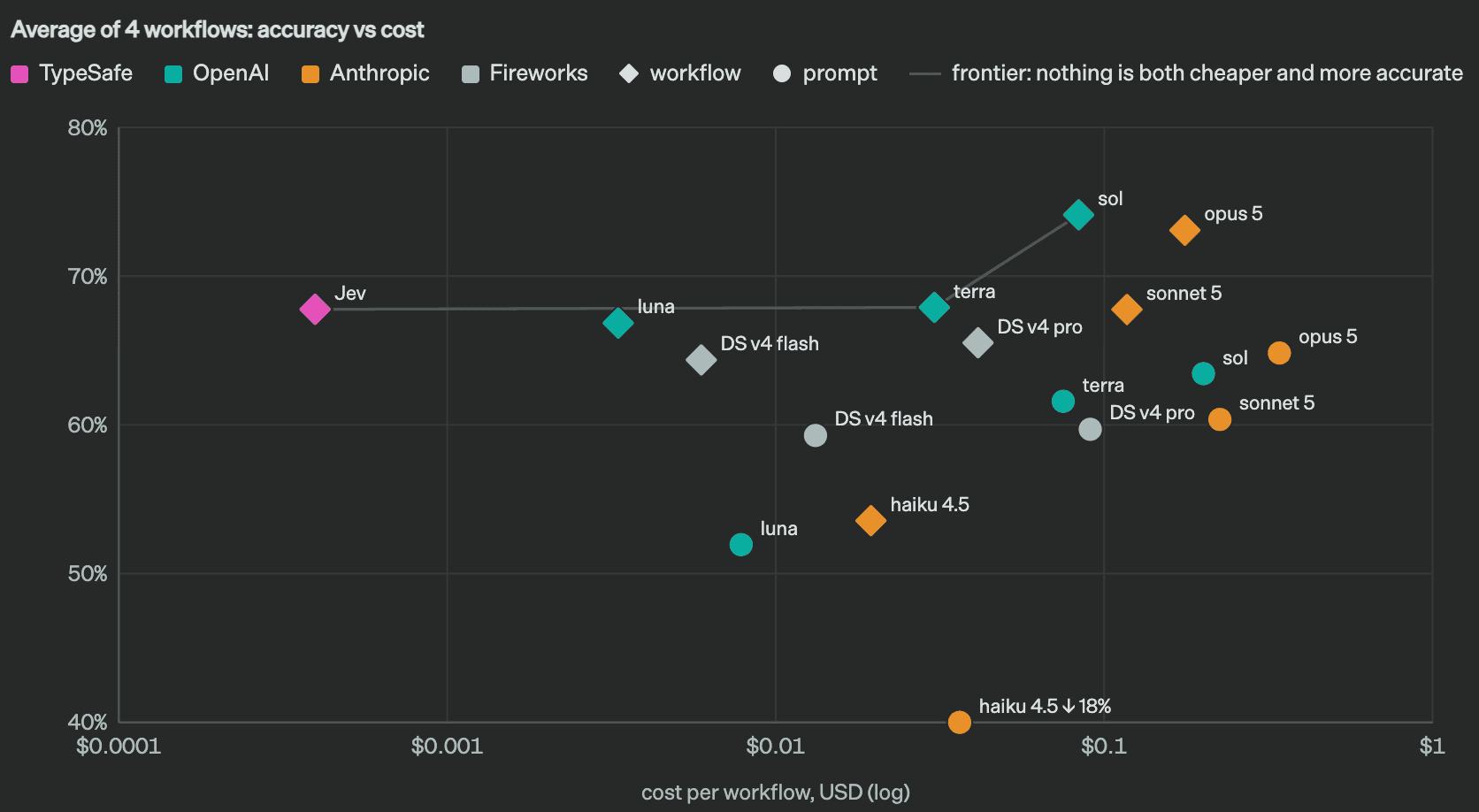
Source: Introducing System One Models and Jev, TypeSafe. Average of four workflows. Jev is the left-hand point.
IEEE Spectrum counted what happened next. In six or seven weeks, Amazon, Cloudflare, Microsoft, and OpenAI had decision models of their own, and independents had shipped dozens more. Jev 1.14, on October 14, turned on images, the box type, and a long-context header that lifts the window from 64K to 262K. TypeSafe still marks the long context and the images as a danger zone: allowed, and less reliable than the short text path.
Who followed Jev
Weights, price, and modalities changed. The request shape did not: state in, typed questions, probabilities out. Dates for models without a launch post here come from the Dbggr tracker.
| Date | Model | What it added |
|---|---|---|
| Sep 15 | Jev (TypeSafe) | First System One model. $0.042 / M input. Text, then images. |
| Sep 28–29 | Drex 1.5 (Nace), d1 (Liquid) | Drex 1.5 open weights. Liquid d1 hosted at $0.02 / M. |
| Oct 1 | Clef, Clef Flash (Cloudflare) | Apache 2.0 weights, 27B and 9B, images. |
| Oct 6, GA Oct 22 | GPT-6 Luna (OpenAI) | Decisions API. $0.10 / M. Up to 400 questions. About 10× faster than Luna on the Responses API. |
| Oct 9 | Microsoft-Decision-1 | 9B, text only, Jev's $0.042 price. |
| Oct 14 | Jev 1.14 | Images, box, long context. |
| Oct 16 | Decider V1.2 (Perplexity) | Open weights on Qwen. $0.02 / M, Flash at $0.01. |
| Nov 11 | Gemini Decision 1 | Audio, video, PDF. Up to 1,000 questions. $0.10 / M. |
| Nov 12 | Decider v1.3 | locate spans. Free variant on OpenRouter. |
| Nov 17 | Microsoft-Decision-1.1 | Gemma 4 26B-A4B, images, more than 2× the speed, same $0.042. |
Perplexity says Decider is inspired by Jev. Microsoft says Decision-1.1 scores 68 on the Artificial Analysis Decision Index v2.1, six points above its first model, and ahead of Jev 1.14, Gemini Decision 1, and GPT-6 Luna, after more than 4,000 customers in preview. Decider's $0.02 price, and a free V1.3, is why it is the other family with nine-figure traffic. A router on every event follows the price.
Why Google shipped it
Google's reason sits in products that were already paying a generative model to pick a label.
On November 11, Min Choi and Felix Yu shipped the Decisions API, with gemini-decision-1 as the only model. One shared input, up to 256K tokens, up to 1,000 questions, scored in a single forward pass. End-to-end latency is 150–250 ms. Input is $0.10 per million tokens. Output is $0. The same call accepts text, images, audio, video, and PDFs. Jev and Luna read text and images. Cloudflare's Clef-omni and Liquid's d1.2 already take audio, and Clef-omni takes video. Google's bet is doing all of that inside the Gemini API, on one input, with a calibration number attached.
Inside Google the endpoint was already a control plane:
- Gemini Notebook routes each query to a model tier and a thinking level. Google says everyday queries land with up to 40% lower latency.
- Search runs it as a safety check on MCP tool calls, inside the latency budget.
- CC picks an emoji from more than 200 options.
- Stitch turns a voice command or a tap into a wireframe edit.
Google's chart measures that replacement against Jev. Against Gemini 3.5 Flash-Lite on the Interactions API, Decision 1 costs $0.88 to run the seven shared evals, against $4.14. That is the "nearly 5× cheaper" line, and it is a comparison with Google's own generative model.
Against Jev 1.14 the scores split. On Google's numbers, Decision 1 scores 92.2% on the public JevBench split, Luna 90.9%, Jev 90.0%. Calibration is the clean win: top-1 expected calibration error of 0.0250, against 0.0494 for Jev and 0.0721 for Luna. Jev still leads Mind2Web Multimodal (86.8% to 86.2%) and When2Call (82.0% to 79.9%), and Jev is cheaper on that suite, $0.68 to $0.88. The audio and video rows, MMAU and Video-MME, are blank for Jev and Luna. That empty column is the product.
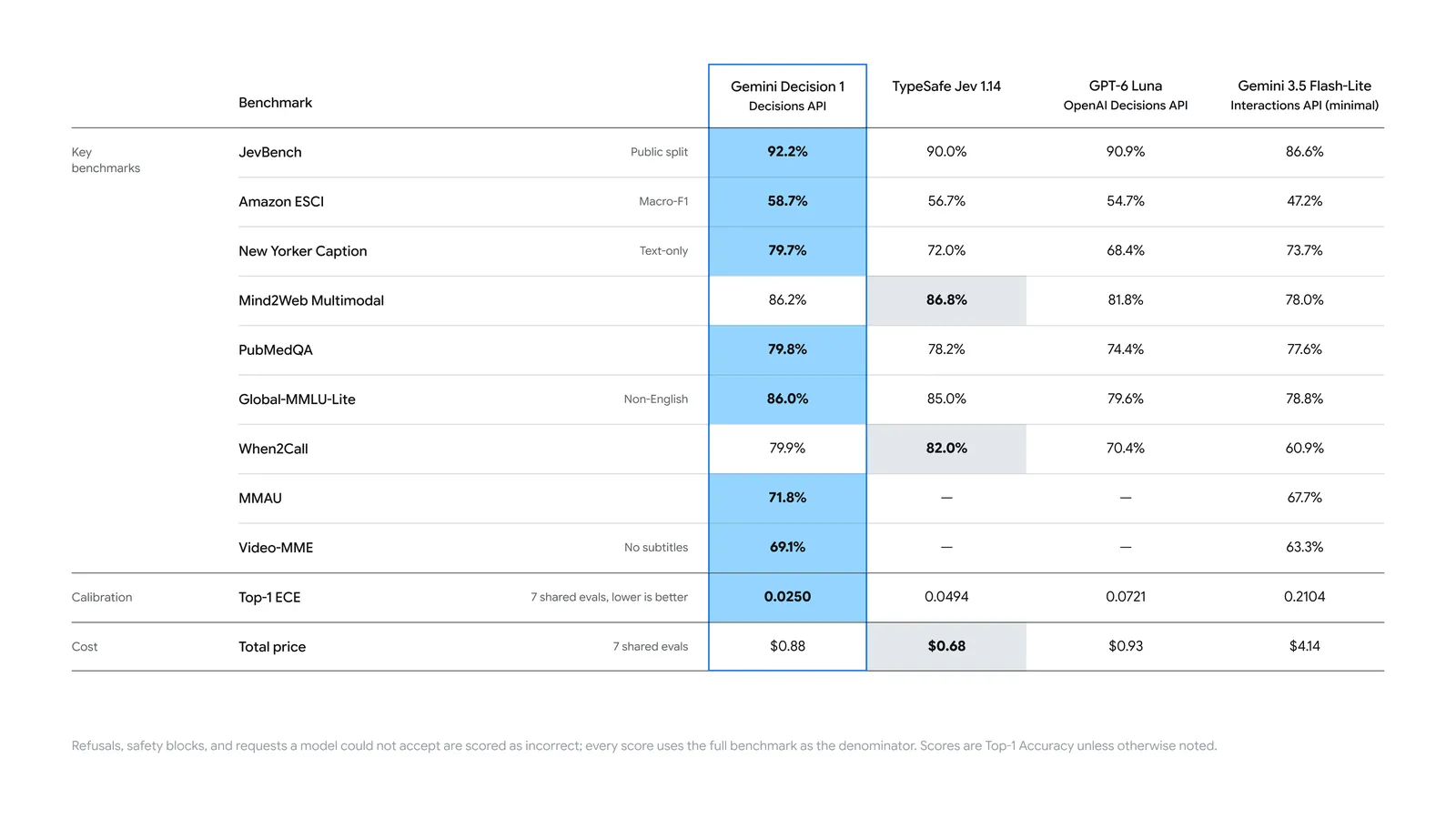
Source: Gemini Decisions API, Google. Blue is Decision 1's best cell. Gray is a rival's.
The request chart lines up with the price. Decision 1 sits with Luna at $0.10. Jev and Microsoft-Decision-1.1 are $0.042. Decider is $0.02. Google's distribution is the Gemini API and AI Studio, with Cloud listed as coming, and the customers named in the launch post are Google's own apps.
The gate in front of a review
A pull request comment is a piece of writing: a finding, a reason, a line. A decision model is the gate in front of that writing. It can score whether a diff looks security-relevant, which specialist should read it, and whether the confidence is high enough to comment or low enough to send to a person. The comment itself still comes from a generative model.
That split is the useful one. Most diffs are ordinary. The expensive model is for the ones that are not. ThinkReview's review on GitHub, GitLab, Azure DevOps, and Bitbucket is that written pass.
Launch details: TypeSafe on Jev, Jev 1.14, OpenAI's Decisions API, Perplexity Decider v1.3, Microsoft-Decision-1.1, and Gemini Decision 1.
Newsletter
Want the next one?
Leave your email and I’ll send the post when it’s published. Models, agents, and the review work in between. No drip after that.
One email when we publish. Unsubscribe in a click.