Outbid.lol and the rise of the AI clone economy
Outbid.lol printed six figures in days. Then hundreds of clones landed. AI made shipping fast enough that a trend becomes an industry overnight. Welcome to the clone economy.

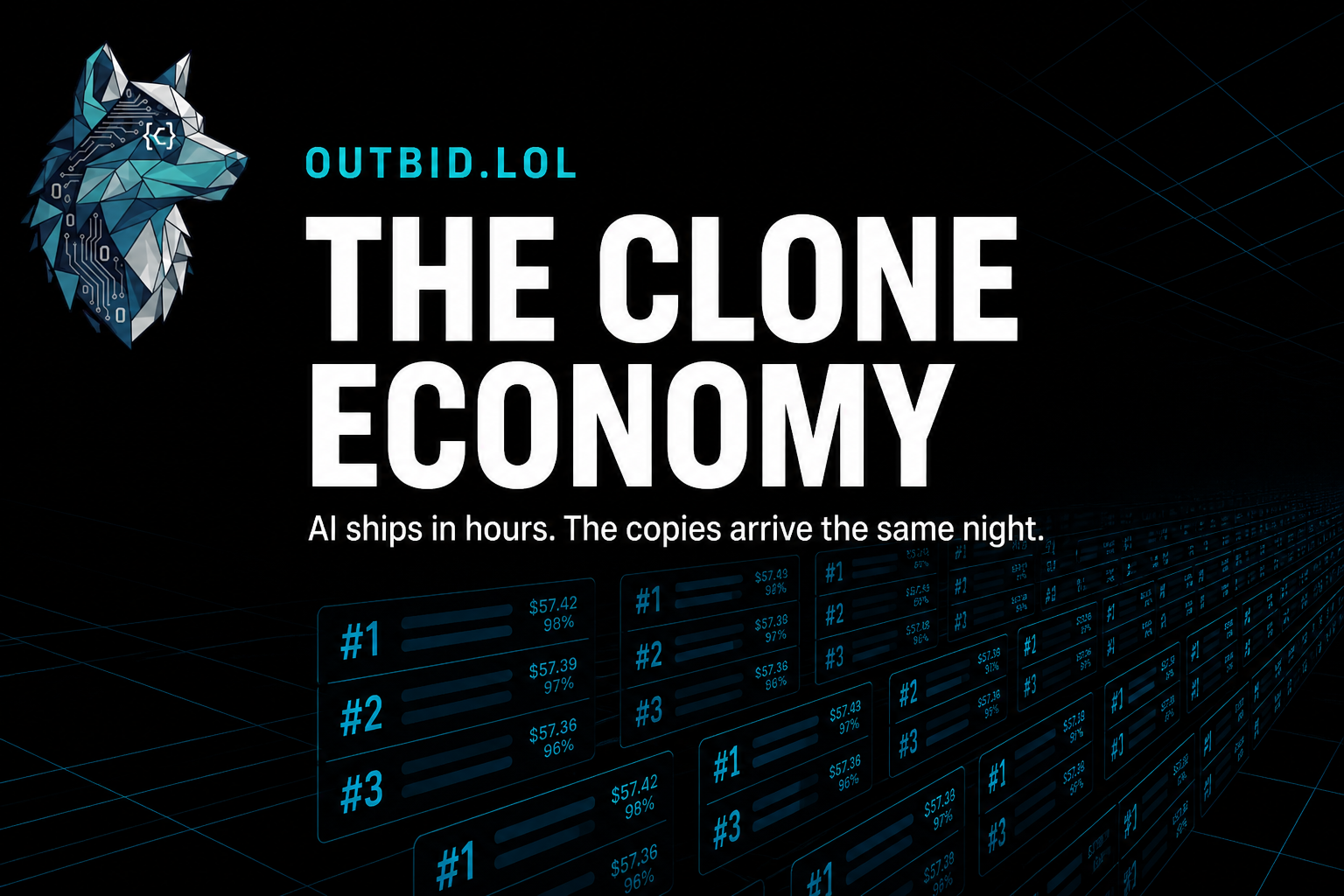
As of 30 September 2026. Pay-to-rank boards flooded X in days. Most of them are a cheap grab. AI made that possible — because it made shipping a format as fast as posting a screenshot.
On August 19, Jonathan Wilke shipped outbid.lol after about three hours of building. The product is one sentence: pay more, rank higher, get seen. Your money is the ranking, printed in public next to your name.
That honesty is why it worked. Founders already suspected every launch directory was pay-to-play. Outbid made the corruption the game.
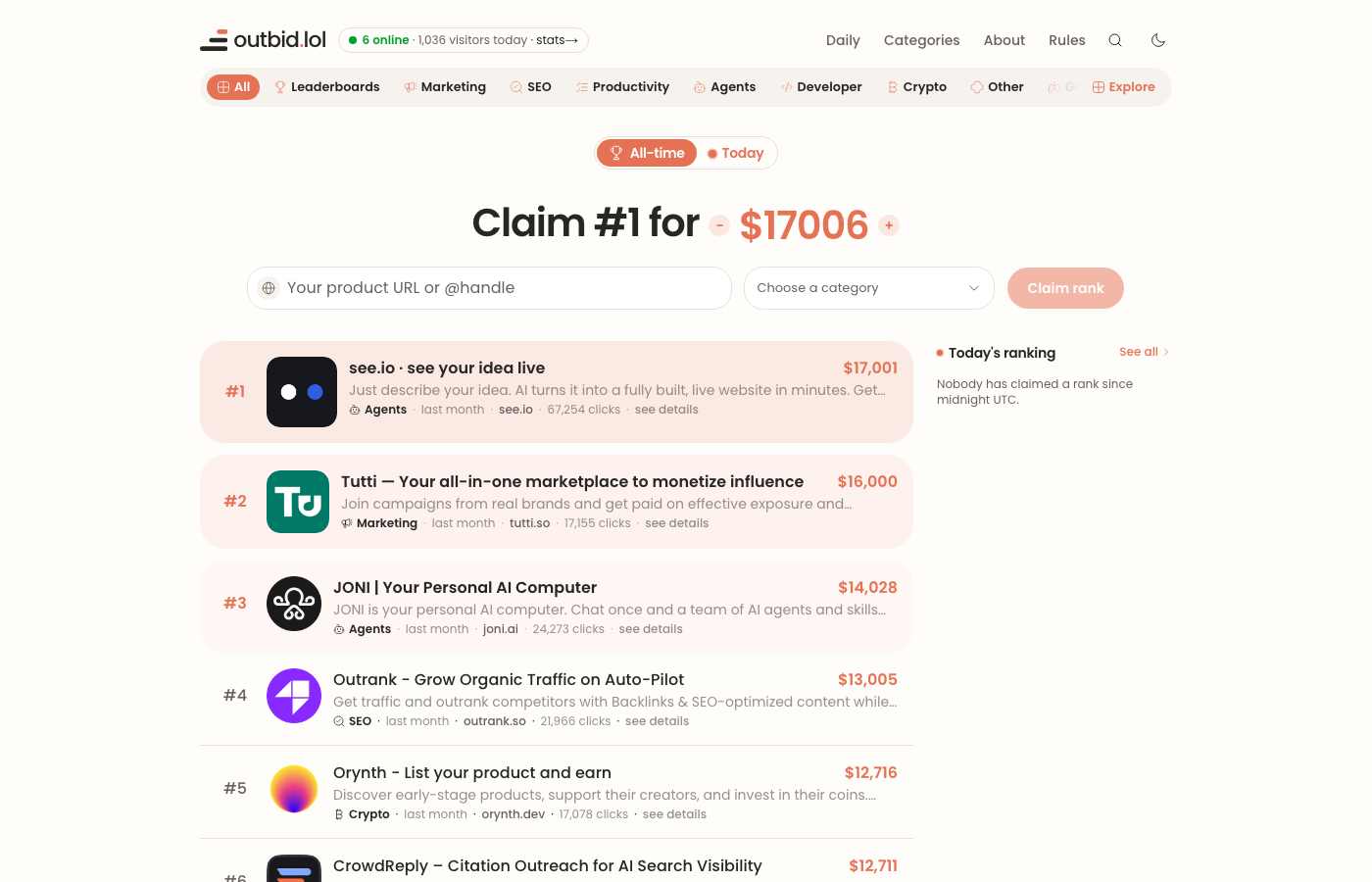
Source: outbid.lol.
The first day reportedly cleared about $21,500 and 200,000+ visitors. An unsolicited $100,000 buyout got declined. Later snapshots put gross near $182,000 in 92 hours, more than a million visitors, and a #1 slot in five figures.
Those numbers are screenshots, not audited books. The feed believed them. That was enough.
Then the clones arrived. Same night. Within days, trackers were counting hundreds of boards. Most of them have no idea. A few of them actually do.
This is the clone economy: a format goes viral, AI collapses the time-to-copy, and the market fills with cashiers before the original's analytics come back online. Apps behave like TikTok sounds. Ship into the spike, extract while the format is hot, abandon the domain when the feed moves. The trend is the product.
This is not a launch. This is a mint
Trackers could not agree on the count. Best X Builds catalogued about 147 boards. Other scrapers talked about 170+. afford.bid listed 357 boards and more than $240,000 in combined bids.
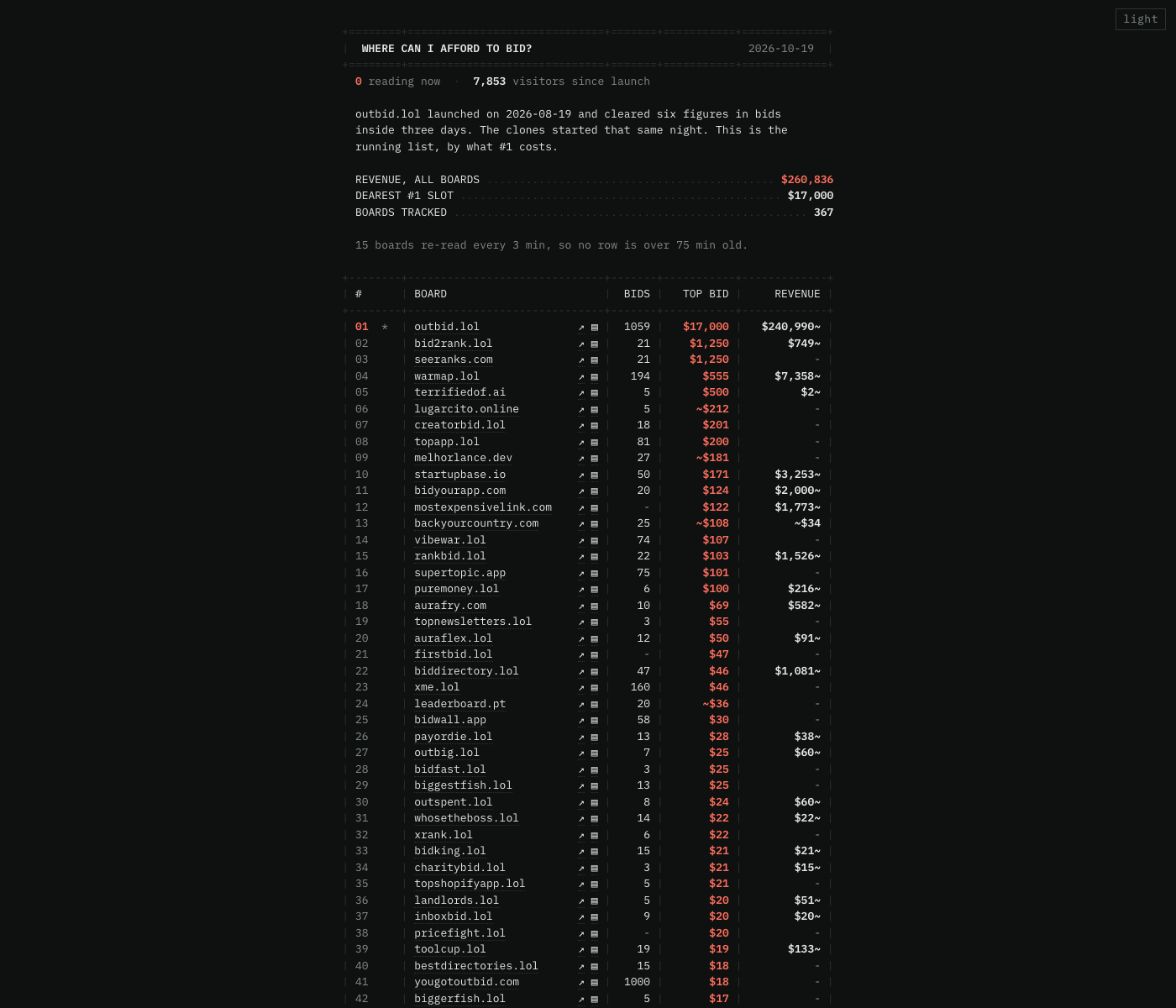
Source: afford.bid. The board keeps moving; the counts above are the September snapshot.
Most of them are the same website with a new domain. rankbid.lol. puremoney.lol. outbidclone.lol. Register a $0.99 .lol, vibe-code a table, wire Stripe, post someone else's revenue screenshot, wait for a fool with a credit card.
That is the NFT playbook with the JPEGs stripped out.
In 2021 you forked a contract, swapped the art, and called it a collection. The originals had a scene. Everything after them was a mint calendar. People were not buying pictures. They were buying a lottery ticket — and shovels for the people who arrived late.
Outbid clones are that lottery with a leaderboard instead of a monkey. The mechanic is copy-paste. The attention is borrowed. There is no product under most of these sites. There is a cashier.
A few years ago we minted JPEGs because minting was easy. Now we mint directories because shipping a directory is easy. The tool changed. The hunger did not.
AI is the factory floor
The clone economy is not new hunger. It is new throughput.
NFT season still had a skill floor. You needed someone who could fork a contract, host metadata, and not brick the mint. That filtered the swarm, a little. The Outbid swarm has almost no filter. Cursor, Claude, Copilot, v0, Lovable — pick a chat window. Paste "pay-to-rank leaderboard, Stripe, live counter, dark UI." Deploy before the original's first recap thread is done.
Wilke built the spark in three hours. That used to be the flex. In the clone economy it is the unit of production. If the original ships in an afternoon, the copies ship in a coffee break. AI does not just help you build a product. It helps you enter a trend while the trend is still a screenshot.
That is the loop:
- See a revenue counter on X.
- Ask an AI to recreate the mechanic.
- Buy a
.lolthat is still 99 cents. - Wire payments. Post your own counter.
- Ride the quote-tweets until the next format shows up.
Vibe coding made a bidding board an afternoon, not a quarter. Cheap TLDs made naming a costume change. Stripe plus a public counter made revenue a screenshot. X already rewards the creator loop: post the spike, quote-tweet the clones, farm the recap. AI glued those pieces into a same-day industry.
Once that stack exists, you do not need product-market fit. You need format-market fit — a mechanic simple enough to screenshot, greedy enough to copy, and timed to a feed that is already looking. Outbid did not invent pay-to-rank. It invented a tradable format. "Outbid for X" is a sentence an AI can scaffold. The original becomes grammar. The clones are the industrial process.
This is different from "move fast and break things." That slogan still assumed you were building toward something that would last. The clone economy assumes the opposite. The app is supposed to be disposable. If it is still up in six months, that is a nice accident, not the plan.
Kits now sell you a working board. Meta-directories rank the clones. Recap accounts turn the swarm into content. The shovels ship faster than the gold — and the shovels are also vibe-coded.
The old SaaS scoreboard was MRR and whether anyone still logged in on a Tuesday. The new one is hours to first dollar, clone count, and whether your revenue screenshot got quote-tweeted. Those metrics produce cashiers, not companies.
Side projects can be jokes. Jokes can make money. The tell is when the default way to ship becomes: find the meme, prompt the meme, cash the meme. That is a mint culture wearing a deploy button.
Cheap scam energy — except the few that mutated
Stripe is real. If you pay, your name probably appears. The shape is still a scam: extract FOMO while the format is hot, before anyone notices that rank on a two-day-old clone with 400 visitors is worthless.
The tells are identical to 2021: speed over taste; the original's numbers as your marketing; directories of directories ranked by bid; .lol as a cash-register costume; late money funding early money. AI just made the tells arrive faster.
If you bid on the original during the viral week, you are buying attention. If you bid on the twentieth clone, you are the exit liquidity. NFT season was full of people who thought they were early because they could still mint. They were early to being the bag.
The people who caught Outbid's first 24 hours got a launch. The people who caught clone #200 got a Stripe form and a story about how they "shipped." Shipping is not the same as arriving — especially when an AI shipped it for you.
The interesting boards stopped being clones. In the clone economy, mutation is the only honest move. An AI can fork a table. It cannot decide which constraint to change unless you do.
- payluck.lol killed the wallet war: fixed price, random coupon, boards that lock.
- warmap.lol made rank into territory. You buy countries instead of rows.
- lowbid.lol inverted it: lowest unique bid wins.
- lastspot.lol capped the board and decayed value.
- pitchpit.lol made it a fight: you pay for the matchup, not the verdict.
Those are riffs. They change a constraint enough that you learn something by using them. Prompting the table is not iteration. Crypto had the same split: a handful of projects with a point, then ten thousand with none. The timeline drowned the good ones. That is X this week.
What dies in six months
Outbid itself may keep a long tail. First-mover plus a million visitors is a real asset. Some bidders already posted trials, demos, and click spikes that look like ads that worked.
The clones do not inherit that. Attention does not clone. The mechanic does — now at AI speed. By 300 boards, the scarce resource is people who still care. Most of these domains will be parked by winter.
That is the clone economy's real tax. It wastes maker hours — and token hours — on products that were never meant to meet a user on a Tuesday. It makes "I shipped" cheaper, and "this is useful" rarer. AI is excellent at both. It does not know the difference.
I would not build a company on a row that exists because .lol was 99 cents and a chatbot could scaffold Stripe. And I would not confuse "I prompted a clone in an afternoon" with "I built a product." We already lived through a cycle where minting was mistaken for making.
This time the jpeg is a leaderboard. The factory is an AI coding tool. The floor is still going to zero. The question is whether the next app you ship is supposed to survive the feed, or whether it is the trend — a three-day cashier with a domain name.
Both can make money. Only one is software.
That is also why we build ThinkReview the way we do: a copilot on the pull request — GitHub, GitLab, Azure DevOps, Bitbucket — meant to still be useful on a Tuesday, not a format that expires when the feed does. AI should help you judge what got shipped, not only help you ship the next clone. Pick a model in Model selection. Run it on a real diff.
As of 30 September 2026. Revenue and clone counts cited here are public snapshots from operator counters and third-party scrapers in the week of August 19–23, 2026. They move constantly and are not audited. This is part one of our clone-economy series — next: how long it lasts and why it is already dying. Ready to review the next PR with a tool that is not a three-day cashier? Install ThinkReview.
Newsletter
Want the next one?
Leave your email and I’ll send the post when it’s published. Models, agents, and the review work in between. No drip after that.
One email when we publish. Unsubscribe in a click.