Claude Ship reviews, fixes, and can approve the pull request
Claude Ship reviews GitHub pull requests, pushes fixes, and can approve them under a repo policy. Code Review is generally available. The rest is beta.

Open the pull request. Claude reviews it, works on the fixes, and can approve what the team's policy allows.
On November 23, 2026, Anthropic introduced Claude Ship. It is in beta on Claude Team and Enterprise, for repositories on GitHub. Code Review is already generally available and posts findings on the pull request. Two new agents, PR Steward and Claude Approvals, are in beta. One works on the fixes. The other applies an approval policy the team writes in the repository.
The delay they describe is the one that shows up once agents write a lot of the code. Someone opens a pull request, starts the next change, and comes back when review, CI, or a conflict needs a person. On the Claude Code team, Anthropic says Claude writes most of the code, and they wanted the steps after the pull request to move at that pace too.
Three agents, one pull request
Claude Ship is those three agents on a GitHub pull request. Repository settings and GitHub branch rules still decide what merges. Anthropic's own diagram is the happy path: findings, a fix, another finding, another fix, then an approval under team policy.
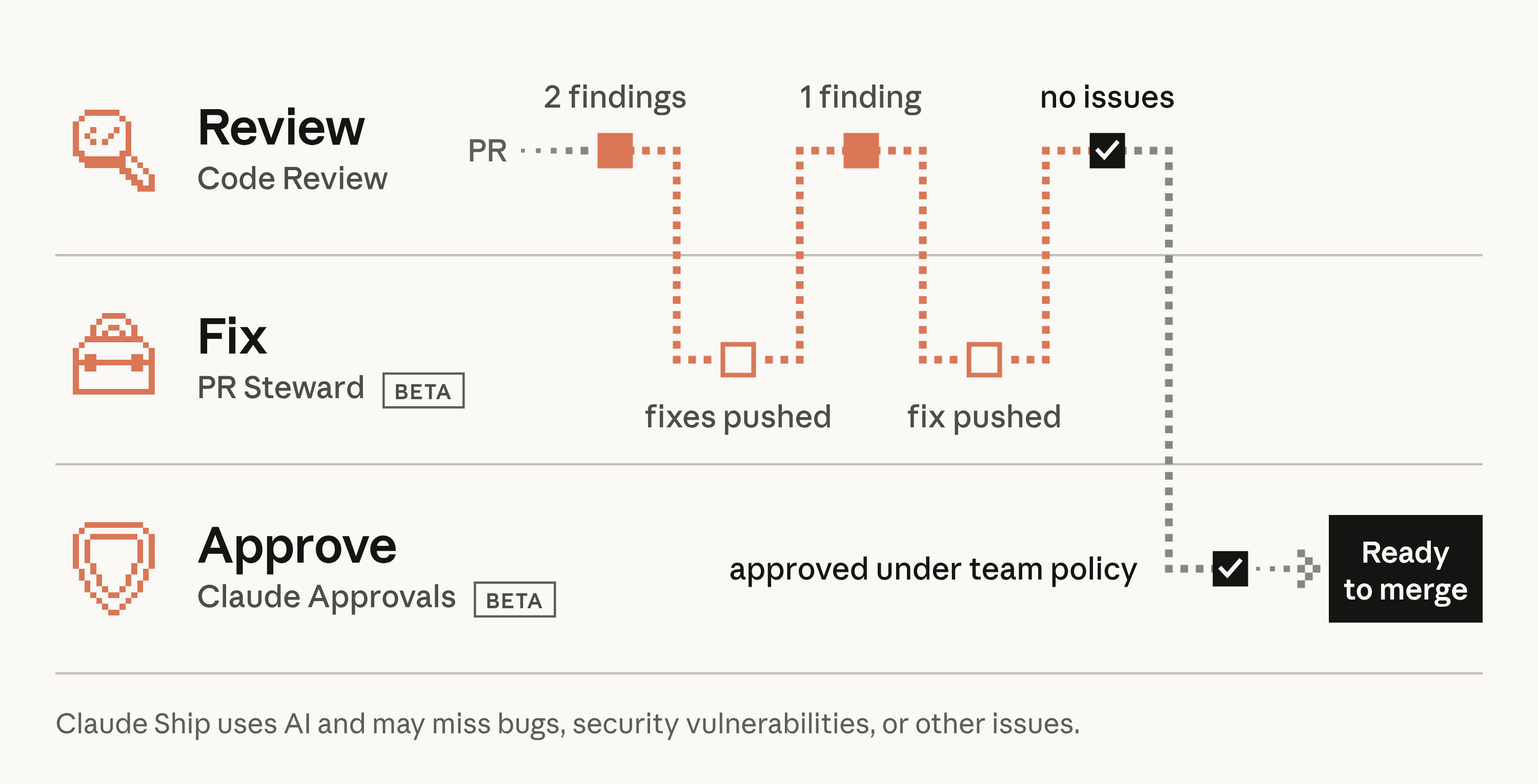
Source: Introducing Claude Ship, Anthropic, November 23, 2026. PR Steward and Claude Approvals are marked beta. The footer says Claude Ship may miss bugs.
Code Review reads the change next to the surrounding code. Several agents look for logic errors, security issues, and broken edge cases. A verification step checks candidate findings against the code before they are posted. What remains shows up as inline comments, ranked by severity, plus a check run named Claude Code Review. That check does not fail the pull request, and a review by itself does not approve or block it.
An Owner picks a review level for each repository: Quick, Standard, or Deep. Standard is the default. The same settings choose when a review runs: once when the pull request opens, after every push, or only when someone with write access comments @claude review. Reviews run on Anthropic's infrastructure. They read the diff and the code around it. They do not build or run the project, and the admin settings do not offer a model picker.
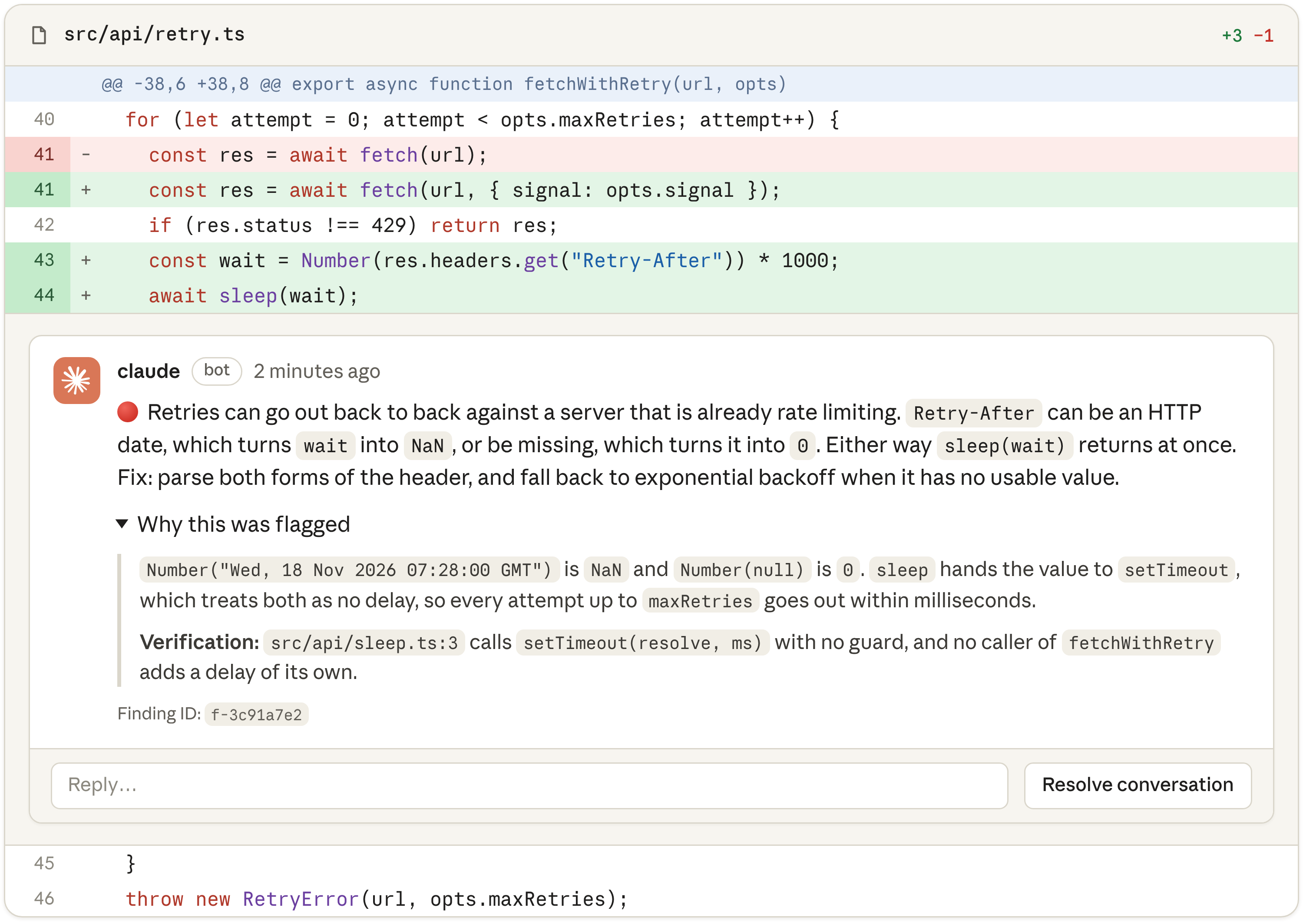
Source: Introducing Claude Ship, Anthropic. The comment cites the line, says why it was flagged, and names the file it checked.
Anthropic's number for its own team: from June to September, with Claude's review as one layer of a broader process, merged pull requests more than doubled, and the share reverted fell by more than 40%.
PR Steward, in beta, tries to keep the pull request green. It works on failing checks, merge conflicts, and review comments from Code Review, other review tools, and people. After each push it comments with what it changed and how to undo it. A @claude comment steers it. @claude stop makes it step back. The PR Steward docs say it is designed so it does not approve or merge. Where an Owner has turned it on, it adds the label claude-pr-steward-watching. It skips drafts, forks, pull requests a bot opened, and authors without write access. An Owner can include drafts, or leave it on Manual so it starts only when someone asks. It picks the work up on GitHub and does the edit in a cloud session.
Claude Approvals, also in beta, reads .claude/approvals.yml on the default branch. The file can require people on some paths and let Claude approve on others. It can weigh Code Review findings, or a classifier the team writes in natural language. Anthropic's comparison is a smarter CODEOWNERS file. The recommendation is to start in observe mode. There, the check reports what the policy would decide, Claude does not approve, and the check normally counts as passing. Enforcement is what can block a merge, and only after GitHub requires that check. A policy file with no mode line is enforced. The docs warn that auto-merge or a merge queue, paired with a policy that does not require a person, can merge a change with nobody acting.
Two ways to turn it on
A developer can try it on their own pull request with /ship in Claude Code. Anthropic says the command pushes the change, opens the pull request, reviews it, and works on feedback and failing checks. What can merge still depends on that person's permissions and the branch rules. The example on the launch post says the watch lasts up to seven days, in that session, on that person's usage, and that the session, the computer, and the checked-out branch need to stay put. /ship stop ends it. The command is rolling out in Claude Code and the desktop app, and it counts as regular Claude Code usage.
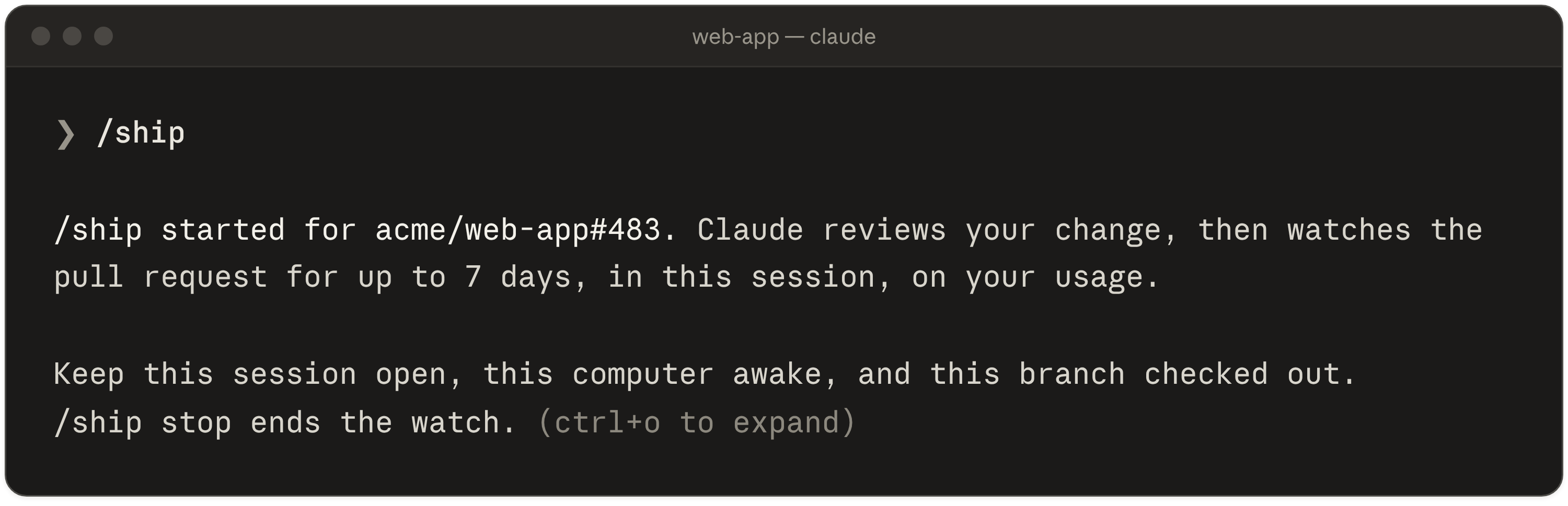
Source: Introducing Claude Ship, Anthropic.
An Owner turns the same agents on for a whole repository from Organization settings, under Claude Ship. The setup guide says to do it one repository at a time, in order: Code Review, then PR Steward, then Approvals. For PR Steward, start on Manual, which is a @claude steward comment, because Steward has no spend limit until you set one. For Approvals, commit the policy in observe mode and read what the check would have decided. Developers on that repository do not have to type /ship. Each repository gets its own review level, its own schedule, and its own spend limit. Existing branch protection and required checks stay in place.
Anthropic's own walkthrough is a docs fix. A product manager asked Claude Tag whether a confusing Analytics API note was already being fixed. Claude opened the pull request. Code Review found nothing blocking, a docs reviewer signed off, Claude Approvals passed, and the fix merged the same evening.
The bill, and the plans left out
Claude Ship is billed on tokens, through the organization's usage credits, separate from the usage included in the plan. Spend follows how many pull requests are covered, how large they are, the review level, how often reviews run, and how much PR Steward does. Admins can cap Code Review and PR Steward. Claude Approvals has no base charge. Classifiers in a policy are billed on the tokens they use, and a policy that asks for Claude's review starts a billed Code Review, including in observe mode.
Eligible Enterprise organizations can claim at least $10,000 in Claude Ship credits, to use within 30 days of claiming. Claims run through January 15, 2027.
The agents are unavailable to organizations with Zero Data Retention, the HIPAA configuration, or customer-managed encryption keys. The managed product is for GitHub, including GitHub Enterprise Server and GitHub Enterprise Cloud with data residency. A team that runs Claude Code through Amazon Bedrock, Google Cloud's Agent Platform, or Microsoft Foundry still needs a Claude organization on Team or Enterprise before an Owner can turn Code Review on.
Vatsal Bhatt, director of engineering at TELUS, describes the split his team kept: Code Review caught issues before a person reached the pull request, PR Steward helped the contributor fix them, and a person stayed on the changes that needed one.
Review the pull request on the host you use
Claude Ship is Anthropic's loop on a GitHub pull request: findings, fixes, and a policy that can approve. ThinkReview reviews the pull request or merge request URL on GitHub, GitLab, Azure DevOps, and Bitbucket. You choose the model in model selection, so the reviewer can be Claude or another family. The review reads the diff the host will merge.
Product details are from Introducing Claude Ship (November 23, 2026), the Claude Ship docs, Code Review, and PR Steward. TELUS quote: Vatsal Bhatt, in Anthropic's launch post.
Newsletter
Want the next one?
Leave your email and I’ll send the post when it’s published. Models, agents, and the review work in between. No drip after that.
One email when we publish. Unsubscribe in a click.