Gemini 4 Hydrogen is the fast Gemini 4
Gemini 4 Hydrogen is Google's fast Gemini 4. It beats Argon on Artificial Analysis, costs less per task than 3.8 Flash, and still trails Sonnet on the terminal.

Google's everyday Gemini 4 beats Argon on one public index, and Sonnet still leads the terminal rows.
On November 12, 2026, Koray Kavukcuoglu introduced Gemini 4 Hydrogen. Carbon and Argon stay the frontier models for long-horizon work. Hydrogen is the model Google wants on the everyday loop: write the change, run the check, recover when a tool call fails. The API id is gemini-4-hydrogen. The model card says Hydrogen is adapted from Gemini 4 Carbon.
Source: Introducing Gemini 4 Hydrogen, Google, November 12, 2026.
What Google shipped
The launch post, the API price card, and the model card line up on the product:
- Four thinking levels. Low, medium, high (the default), and a new xhigh tier. Argon stops at high.
- One million tokens, one price. Input, thinking, and output share a 1,048,576-token window. A synchronous reply defaults to 65,536 tokens. Background long decode can run to 1 million. The knowledge cutoff is March 2026. Output is text.
- The rate card. $1.50 per million input tokens and $7.50 per million output tokens, thinking included, with no long-context surcharge. Cached reads are $0.075. Caching is implicit only. Explicit caching is off for Gemini 4, Hydrogen included. Free-tier prompts may be used to improve Google's products. Paid-tier prompts are not.
- The jump from 3.8 Flash, in Google's words. 2.5 times faster at the default high setting, Terminal-Bench 4.1 at 57% versus 18.2%, and more than five times fewer fabricated claims. In partner tests on graphs, SQL, and data-heavy work, Hydrogen ran 2 to 2.8 times faster and used 12% to 23% fewer tokens.
- The regression on the card. Unjustified refusals are up 5.57 points versus 3.8 Flash, especially on multimodal prompts. Image-to-text safety is up 7 points. Google says Hydrogen does not reach the biological or cyber critical capability levels, and that it does reach the alert thresholds for both. The full safety report is listed as coming soon.
Gemini 3.8 Flash stays at $0.75 / $3.75 through December 31, 2026, then moves to $1.50 / $7.50 on January 1, 2027. Hydrogen's token price is double Flash until that date. Argon and Carbon stay at $2 / $10 through November 30, then $4 / $20. Hydrogen is outside that increase.
What people posted on launch day
Sundar Pichai described the rollout in one note: four thinking levels, so you wait and pay for the depth a task needs, live the same day in AI Studio, the Gemini API, the Gemini app, Search, and paid Pro and Ultra inside Antigravity.
Demis Hassabis quoted the API announcement and called Hydrogen everyday coding and agentic work.
Logan Kilpatrick added the line that is easy to miss under the benchmark table:
as just one comparison, Gemini 4 Hydrogen finishes tasks 2.5x faster than 3.8 Flash, while being much smarter, and with 5x less fabrications. it is a good model : )
On that same thread he wrote that he has been using Hydrogen daily, alongside thousands of people across Google.
Google AI pointed the coding demo at Geminisland, a shared voxel island where one prompt adds a structure through the Gemini API, and at a 3D checker in AI Studio that inspects a file, catches errors, and patches them before export.
The independent read arrived the same afternoon. Artificial Analysis posted that Hydrogen sits just under Claude Sonnet 5.5 and GPT-6.1 Sol, at about a third of Sonnet's cost and about 2.5 times the cost of GPT-6.1 Sol. It is Google's third new model in six weeks, and the first Gemini 4 with an xhigh setting.
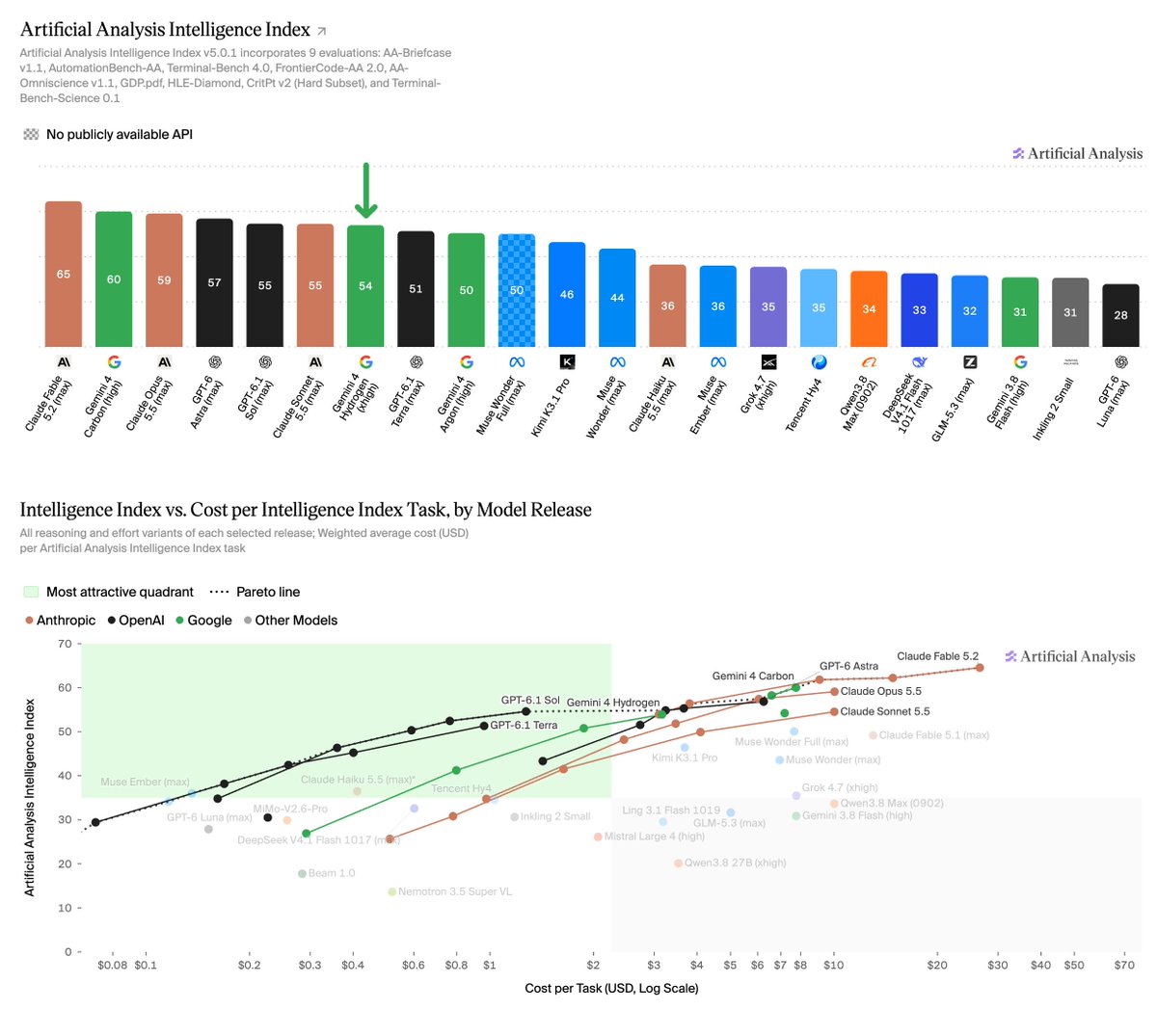
Source: Artificial Analysis on X, November 12, 2026. Intelligence Index v5.0.1. The Hydrogen xhigh bar is 54.
Their release page splits the four settings. Xhigh scores 54 in 13.0 minutes at 198 tokens per second, about $3.16 a task. High, the default, scores 51 in 6.0 minutes at 236 tokens per second. Medium is 41 in 3.7 minutes. Low is 27 in 1.3 minutes, at $0.29 a task. Xhigh is also the verbose one: 304 million output tokens across the index. The Decoder, reading the same cards, put high at $1.87 a task and medium at $0.80, and reported an 8% hallucination rate on AA-Omniscience.
Google's table, grey cells included
DeepMind's comparison is the one to keep beside the index. Hydrogen leads Claude Sonnet 5.5 and GPT-6.1 Terra on SWE-sweep, Agents' Last Exam, AutomationBench-AA, Vending-Bench 2, MKA, Chartography, and HLE-Diamond. Sonnet leads Terminal-Bench 4.1, 63.9% to 57.0%, and also leads OSWorld-2.1 and Terminal-Bench-Science 0.1. Terra has no Terminal-Bench 4.1 number on that card.
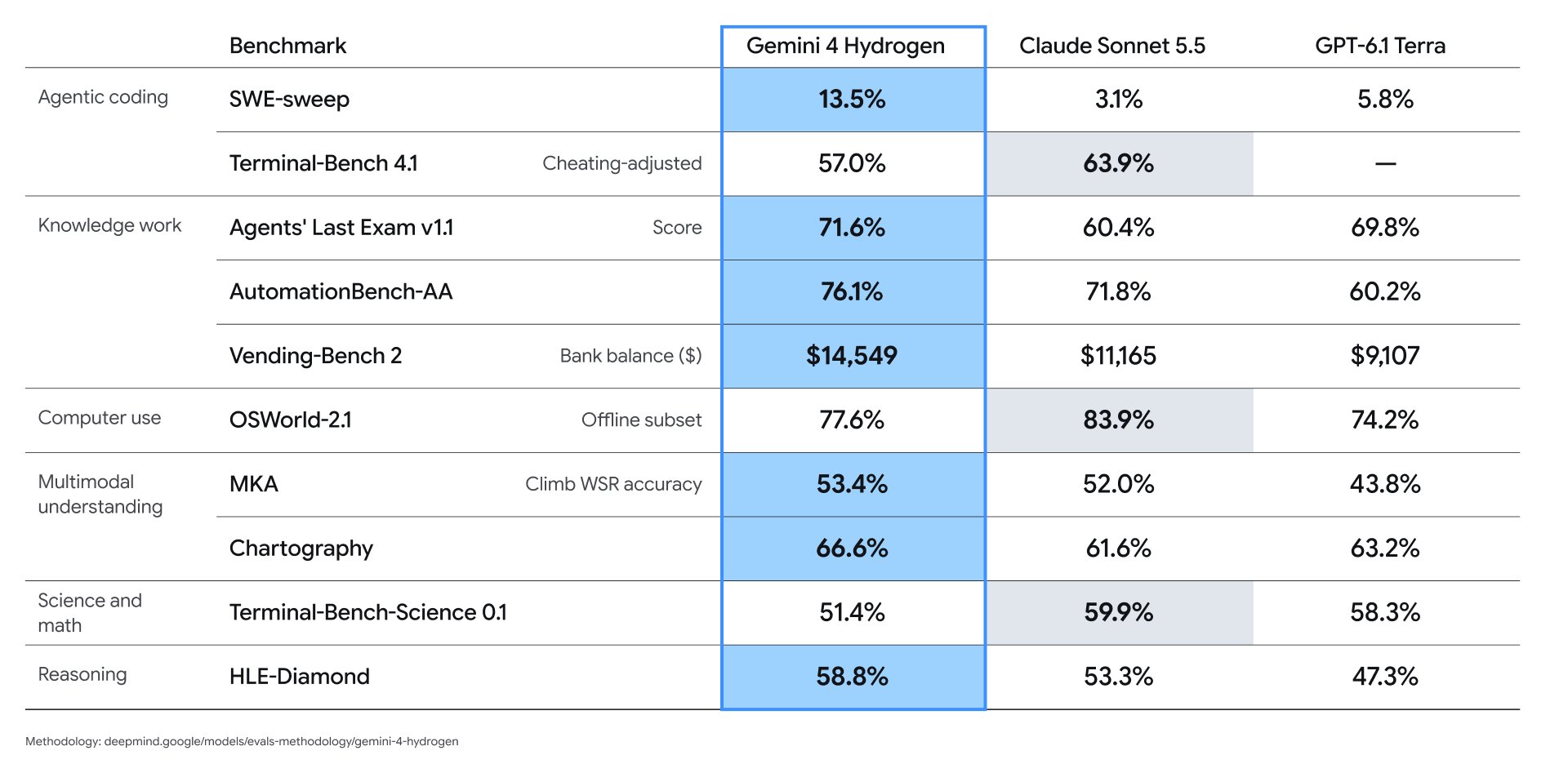
Source: Gemini 4 Hydrogen model card, Google DeepMind, November 2026. The same table went out with Google DeepMind's launch post.
SWE-sweep is the row closest to "find the bug and leave the rest of the file alone." Hydrogen's 13.5%, against 3.1% and 5.8%, is a wide lead on a test most runs still miss.
Antigravity is the multi-model version. Orchestrator starts on Carbon to read and plan, hands edits and tests to Hydrogen, and hands back when Hydrogen gets stuck. The launch post measures that handoff on Terminal-Bench 4.0: near-Carbon success, 24% less quota, 19% faster. The Antigravity post names Terminal-Bench 4.1 for those same two savings. Hydrogen in Antigravity is on paid Pro and Ultra. Orchestrator is on Ultra, and on Gemini for business.
What this changes in a review
A pull request review is a diff, the calls around it, and a comment that reports a real bug. Hydrogen's public case for that job is the cut in fabricated claims, the parallel file reads Google describes, and a flat 1M-token price under Argon. The terminal and computer-use rows are the reason to keep a second model: on Google's own card, Sonnet 5.5 is ahead there. Xhigh's verbosity is the reason to leave that setting off for a short review comment.
High is the setting that matches a review note. Xhigh is for a multi-step bug that high already failed to explain. Gemini 4 Argon remains the Gemini 4 model in ThinkReview model selection. Hydrogen is on the Gemini API. It is not in that catalog yet, so a ThinkReview review cannot select gemini-4-hydrogen until the catalog includes it.
The split Google published still maps onto the reviews you can run today. Use a fast model on the ordinary diff. Use Argon, or Sonnet, when the review has to live in a shell or a long chain of tool calls.
ThinkReview runs that review on GitHub, GitLab, Azure DevOps, and Bitbucket.
Prices and scores reference Google's announcement (November 12, 2026), the model card, API pricing, Artificial Analysis, and The Decoder. Posts: Sundar Pichai, Demis Hassabis, Logan Kilpatrick, Google AI, and Artificial Analysis.
Newsletter
Want the next one?
Leave your email and I’ll send the post when it’s published. Models, agents, and the review work in between. No drip after that.
One email when we publish. Unsubscribe in a click.