ChatGPT says it handles a fifth of Google's searches
OpenAI says ChatGPT web searches are about 20% of Google's query volume. The figure counts queries, not Google's search ads.

ChatGPT says it handles a fifth of Google's searches
OpenAI's 20% figure is a count of queries that trigger a web lookup. It is not a claim on the ad money Google still collects.
On Monday, OpenAI told reporters that ChatGPT now runs about as many web searches as one-fifth of Google. The Verge published the account on 3 November 2026. Adam Fry, ChatGPT's consumer product lead, said a search is any prompt that results in a web lookup, as opposed to defining a term or walking through a simple how-to. On that definition, ChatGPT's search volume is roughly 20% of Google's.
Fry did not say where the Google number came from, and Google does not publish a query count. The comparison is still the sharpest public claim a rival has made. At Google's 2023 antitrust trial, Microsoft chief executive Satya Nadella said Bing had about 3% of search after more than a decade of trying. Twenty percent of volume, even on OpenAI's own definition, is a different league from that.
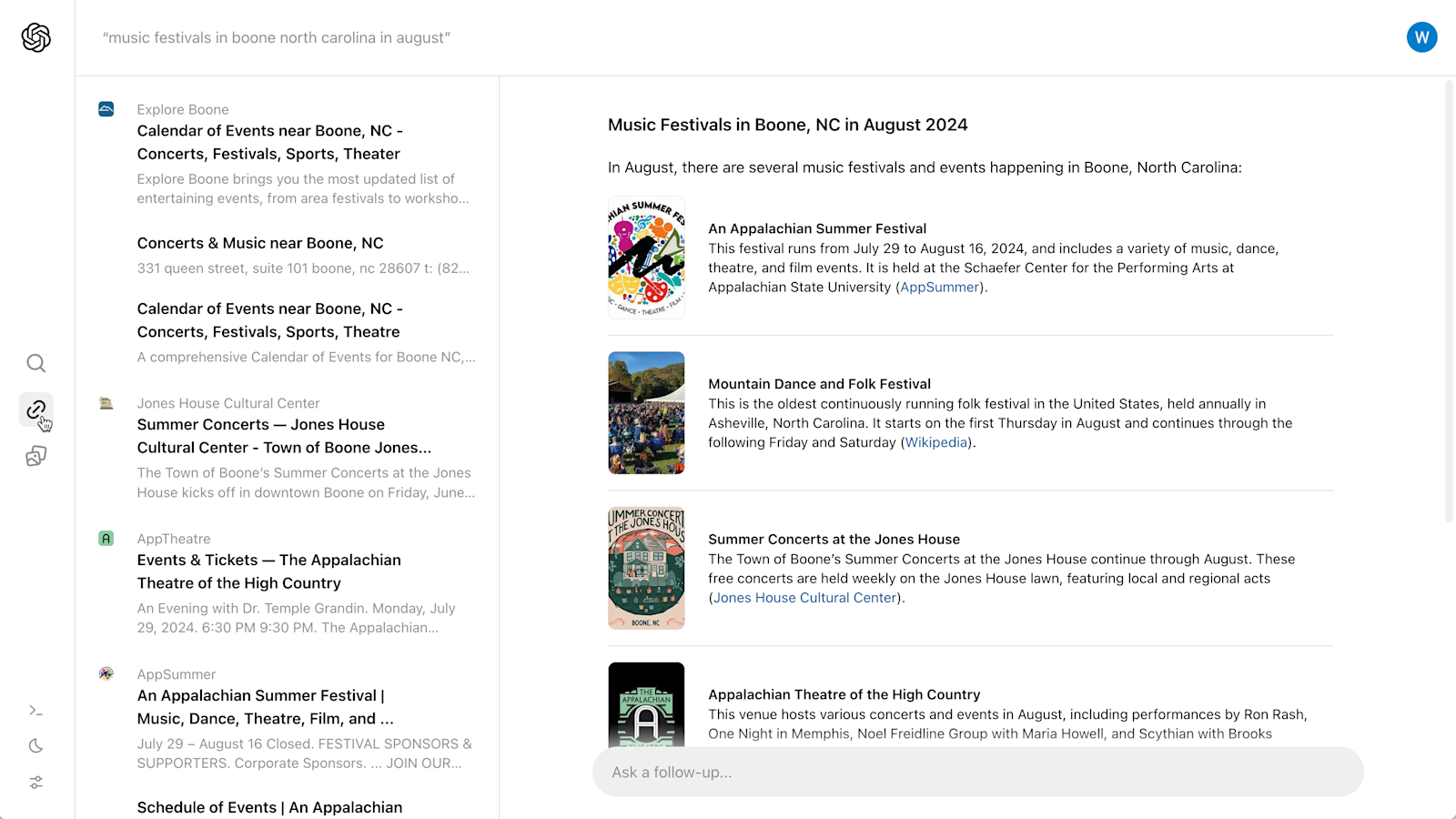
Source: SearchGPT prototype, OpenAI. The company later brought this search experience into ChatGPT.
What the 20% leaves out
The product in that screenshot is an answer with links, not a page of ads. That shape is why the volume number and the money number diverge.
Google's Search & other line, which is advertising, took in $63.35 billion in the quarter ended 30 September 2026, up 12% from a year earlier, according to Alphabet's earnings release. One quarter of that line is already a run rate above $250 billion. OpenAI's entire advertising business is not in that neighborhood. On 31 August 2026 the company said ChatGPT Ads had reached a $1 billion annualized revenue run rate, less than 200 days after launch, with tens of thousands of advertisers.
A chatbot that processes a fifth of Google's lookups is not collecting a fifth of search advertising. Google's machine is built for commercial intent: a product, a place, a comparison, a booking. A large share of ChatGPT use is writing, coding, and conversation. Some of those prompts fire a web search in the background. A person would not have typed them into a search box, and they do not carry a shopping ad.
Early advertiser math points the same way. A working paper from researchers at WU Vienna and the Frankfurt School, covered by Search Engine Land, looked at U.S. traffic across nearly 1,900 sites from June 2025 through August 2026. Paid ChatGPT visits produced about $0.89 of revenue per session, against $2.45 for Google Search ads. Conversion was 0.37% versus 1.17%. Of 87 advertisers on both channels, 97% earned less revenue per ChatGPT visit. The researchers estimated ChatGPT ads would need to cost about $0.26 a click to match Google's return; one disclosed advertiser was paying $1.72. The study is observational, and revenue tied to the visit can miss a purchase that happens later. It is still a wide gap.
OpenAI's answer is more ads
Fry told reporters the ads already in ChatGPT have not hurt usage. "Most people do not seem to mind ads in the product," he said, and then: "Ads have maybe shown us that we could be doing this more, actually."
They are doing more. On 5 October, OpenAI introduced a visual ad format: images of a product or a service, tested during image generation for people on the Free and Go plans, labeled and kept separate from the picture being made. That matches what The Verge described as a step past a name, a logo, and a link. The Verge also reported that OpenAI sees ads as a path toward an IPO that could come early next year.
The principles OpenAI publishes with the ads are worth keeping in view while the format spreads. Ads are not supposed to change the answer. They sit under the response, or beside a generated image, and advertisers do not get the conversation. The August note said an advertising-supported free tier is how the product stays available to more than a billion weekly users. The 5 October post put weekly reach at 1.2 billion. Distribution is no longer the constraint. Revenue per query is.
The nearer hit is on Google's own page
If 20% of Google's lookups had moved, and if those lookups were the commercial ones, Search & other would not have grown 12% last quarter. It did grow, and it grew more slowly than the 17% Alphabet reported for the second quarter, when the same line was $63.27 billion. The quarter-to-quarter change is almost flat: $63.27 billion, then $63.35 billion.
Chief executive Sundar Pichai said on the third-quarter call that year-over-year query growth, including commercial queries, was the fastest in five years. More questions, less additional ad revenue. Currency was the largest reason the growth rate eased. Chief business officer Philipp Schindler also pointed to lower monetization in AI Mode, which earns less than a classic results page. That quarter, and the stock move that followed, is the companion piece on Alphabet's worst day.
ChatGPT can keep taking the open-ended question. The ad dollar still concentrates where someone is ready to buy, and that page is still mostly Google's. The pressure on that dollar, so far, is Google answering the question itself before the ads get a full set of slots.
The question moved. The diff did not.
A search box is no longer the only place a question gets answered. A code change still gets reviewed on the pull request. ThinkReview reads the diff and posts the finding as a comment on GitHub, GitLab, Azure DevOps, and Bitbucket. The model is a choice in Model selection. The review stays on the request the author already has open.
Newsletter
Want the next one?
Leave your email and I’ll send the post when it’s published. Models, agents, and the review work in between. No drip after that.
One email when we publish. Unsubscribe in a click.