Why ChatGPT Atlas failed
ChatGPT Atlas stayed on the Mac for ten months. People kept Chrome. OpenAI folded the browser into ChatGPT Work and shut Atlas down on 9 August 2026.

The agent mode was real. The ask, that you make a new Mac browser your default, was the part that did not survive ten months.
ChatGPT Atlas failed as a browser people would switch to. The useful idea, a page the agent can see and click, survived inside ChatGPT Work. On 9 August 2026 the Atlas app stopped. The tabs, the downloads, and the logins moved into the ChatGPT desktop app. What happened to ChatGPT Atlas is the timeline. This is why that timeline is so short.
The demo was the product
Atlas launched on 21 October 2025 with a clear picture. A sidebar called Ask ChatGPT could read the page you were on. Agent mode could take the wheel: open a store, search, add the usual items, and stop when you said stop. OpenAI's own launch art showed it on Instacart, filling a beach list while the person watched.
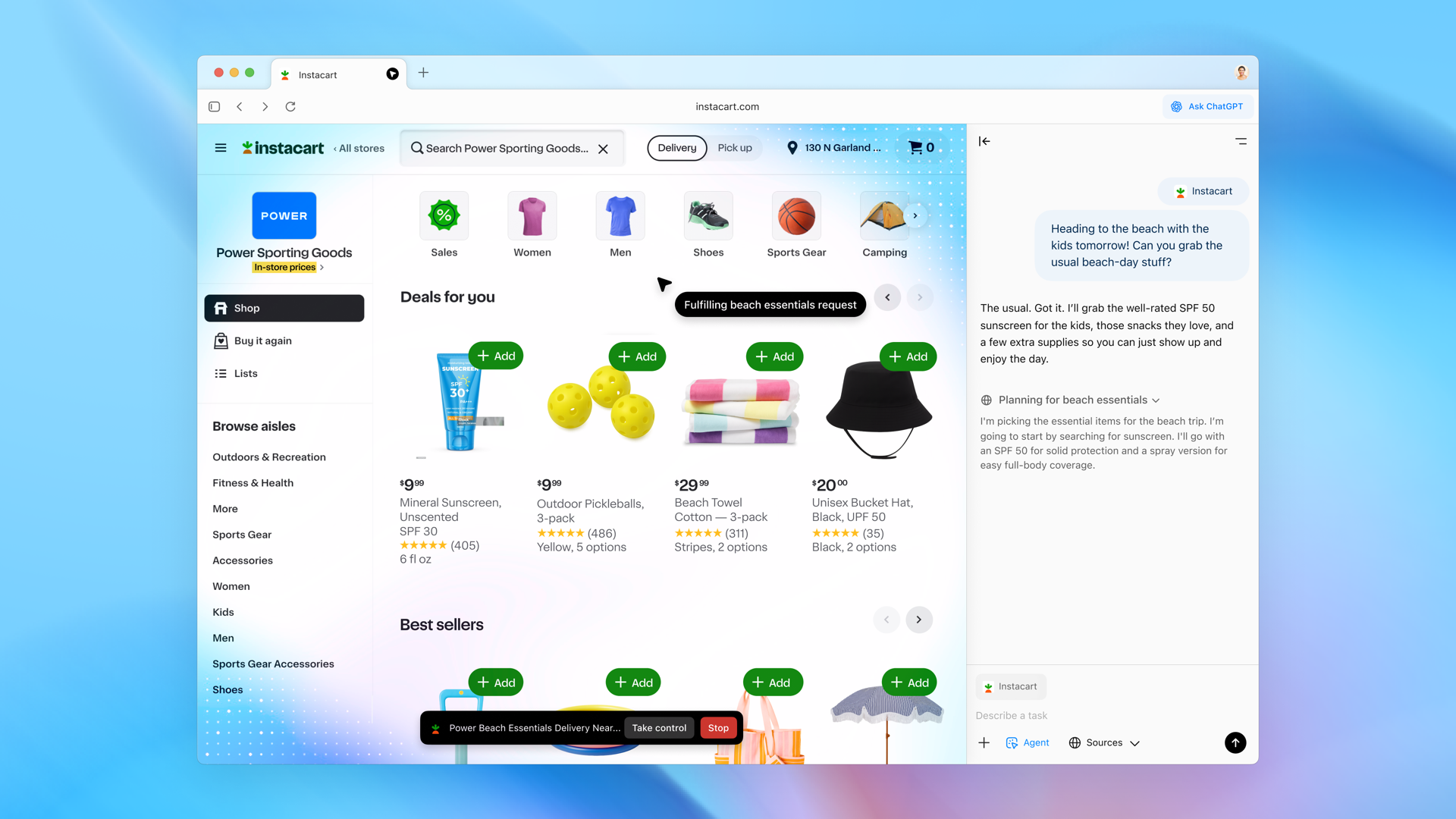
Source: Introducing ChatGPT Atlas, OpenAI.
That picture is why the browser felt inevitable in the autumn of 2025. The page was already the context. The click was already the last step. A chat window made you paste both. Atlas put ChatGPT on the page and let it act, on sites you were signed into, with a preview label for paying plans.
The picture also named the risk. An agent that shops with your login is a different product from a sidebar that summarizes an article. OpenAI shipped both in one app and asked you to trust that app with the whole browsing day.
Ten months, one platform
Atlas launched on macOS. The launch post said Windows, iOS, and Android were coming soon. They did not arrive as Atlas. When OpenAI turned the app off, the replacement desktop app was the one that ran on Mac and Windows. The browser people were supposed to adopt had spent its whole life as a Mac download.
Bookmarks, extensions, password managers, and a decade of Chrome habits do not move because a sidebar is clever. OpenAI's later instructions admit the practical version of that fact. For work that depends on your real Chrome profile, they point you at the ChatGPT Chrome extension. For deeper agent work, they point you at the ChatGPT desktop app. The standalone browser is the part they dropped.
A Chromium fork is also a second app to install, explain, and keep current. Most people already had a browser open, and they already had ChatGPT. Atlas had to beat both, every morning, for someone who had no reason to change the default.
A browser is a product you have to patch forever
Nine days after launch, OpenAI published how they built Atlas. The engineering post describes OWL, a layer that runs Chromium outside the main app so the SwiftUI shell can start fast and survive a renderer crash. That is a serious browser investment. It is also a bill that never ends. Browsers need security updates for as long as anyone leaves them installed.
The July 2026 shutdown notice says this in plain language. A discontinued browser that once held a login is a bad thing to leave on a disk, and OpenAI did not want users staying on an app that would stop receiving patches. The Verge put the decision next to a wider cut of side projects, with Atlas folded into the desktop plan that became ChatGPT Work.
The maintenance cost and the distribution cost landed on the same app. OpenAI could keep paying one of them, inside a product people already open. Paying both, for a Mac browser with a promised Windows build, lost.
ChatGPT Work kept the session
What survived is the part the demo actually needed.
ChatGPT Work, in the new desktop app, can research, draft, and finish files with your tools connected. The built-in browser on that app supports multiple tabs and agentic work across sites and accounts. It is available on Mac and Windows desktop for every plan, and on the web and mobile for Plus, Pro, Business, Enterprise, and Edu. Codex sits in the same app for code. The old ChatGPT desktop app can remain installed as ChatGPT Classic. New agent features, Work included, are in the new app.
That is a narrower claim than "replace Chrome." It is the claim Atlas should have made. Bring a browser to the agent. Leave the default browser alone.
Perplexity's Comet made the wider claim and is still installed. The agent work people do now is still drifting to the same kind of desktop, which is the subject of why Perplexity Comet failed.
The pull request was never going to be a new window
An agent that can click is a way to finish a chore in a store, a form, or a dashboard. A code review is a comment on a diff the author already has open. Moving that comment into a separate browser would repeat Atlas's mistake at a smaller scale.
ThinkReview stays on the merge request in GitHub, GitLab, Azure DevOps, and Bitbucket. The model is whichever one you pick in Model selection. The browser can stay Chrome. The review can stay on the request.
The launch scope is from Introducing ChatGPT Atlas and How we built OWL. The shutdown is OpenAI's wind-down notice. Work's availability is from ChatGPT Work. Install ThinkReview.
Newsletter
Want the next one?
Leave your email and I’ll send the post when it’s published. Models, agents, and the review work in between. No drip after that.
One email when we publish. Unsubscribe in a click.