Merge requests still matter when you never wrote the code
AI let non-coders launch SaaS. The process that saves them is still the merge request — and ThinkReview can review it from Cursor, Copilot, or Claude Code in three words.

The pull request was invented for teams that ship together. It is now the only honest interface between a founder and an AI that ships alone.
A lot of new SaaS products this year have a founder, a Stripe key, and an AI coding tool — and no one on the team who could pass a staff-engineer interview. That is not an insult. It is the product of AI writing tools. Young founders with no coding experience are launching real platforms because the agent can write the CRUD, the webhook, and the onboarding email.
What they skip, almost every time, is the process that made software companies survive the last two decades: branch, merge request, review, merge.
You can skip it for a landing page. You cannot skip it for billing, auth, or anything that touches another user’s data.
Why the MR is not bureaucracy
A merge request (or pull request — same idea, different host) does three jobs that a chat transcript cannot:
- It freezes the change. This commit list, these files, this URL. Not “the thing the model said it did.”
- It creates a decision. Merge or don’t. That is a better question than “does the demo click?”
- It leaves a record. When the trial logic breaks in November, you can see which weekend the agent invented
lemonSubscriptionIdon the client.
If you merge from the agent straight to main, you have a product with no memory. If you open an MR and never read it, you have ceremony without the benefit. The value is the review, not the purple “Open” badge.
First-time founders often treat review as something senior engineers do to juniors. In an AI-built SaaS, you are the only reviewer. The agent will not protect you from itself.
A process you can actually follow
You do not need a 40-page handbook. You need a loop you will still run on a Tuesday:
- One branch per change. “Add trial cancel” is a branch. “Rewrite the app” is how you lose the plot.
- Open the MR as soon as the agent says it is done. GitHub, GitLab, Azure DevOps, or Bitbucket — pick the host, keep the habit.
- Review the diff, not the demo. Click the happy path after you have read the cancel path, the error path, and the permission check.
- Write down what you will not ship. Critical billing or auth issues block the merge. Style nits do not.
- Send the findings back to the same agent. Then open the next MR for the fix, or push to the same one. Review again.
That last “again” is the part vibe-coded companies skip. The first review finds the bug. The second review confirms the fix did not invent a new one.
ThinkReview is the reviewer you can hire in a sentence
ThinkReview is built for this loop. It is a copilot on the PR page — not a bot that merges for you. It reads the real diff and explains issues in language a non-engineer can take action on.
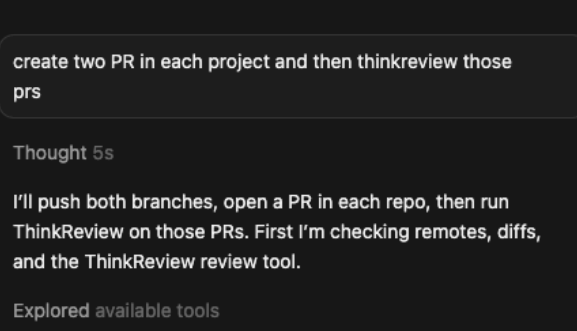
With ThinkReview MCP, that reviewer sits inside Cursor, GitHub Copilot, and Claude Code. After a one-time connect (OAuth recommended), you ask in plain language. Often it is three words:
thinkreview those PRs
The assistant calls review_url_code, ThinkReview loads the live MR, and you get severity plus a business-readable explanation. Example from a Cursor session on two real PRs: one critical cancel-failure path that still returned HTTP 200, and a webapp trial offer that swallowed checkout errors while inferring eligibility on the client.
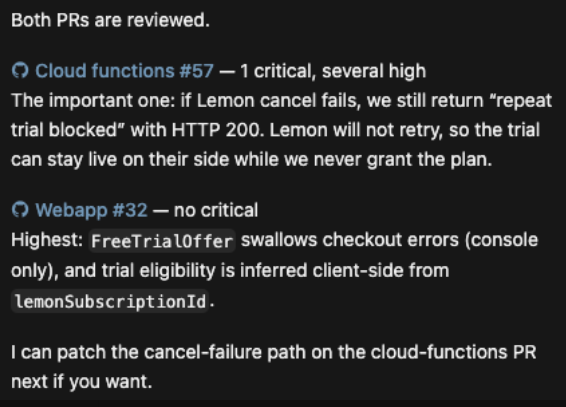
Those are the findings a founder who “doesn’t code” still needs to understand. The merge request made them visible. ThinkReview made them readable. The agent that wrote the bug can patch it — after you decide it matters.
How to connect each client, including git credentials and OAuth, is in the MCP Integration docs.
The boom rewards speed. Customers reward process.
AI writing tools created a generation of SaaS that can appear in a weekend. That is the boom. The companies that remain will be the ones that treated every agent change like a teammate’s change: isolated on a branch, opened as a merge request, reviewed before it reached production.
You do not have to learn to write the code to respect that process. You have to refuse to merge a story.
Open the next change as an MR. Connect ThinkReview from portal.thinkreview.dev/mcp. Ask your assistant to review it — in three words if you want. Then merge like someone is going to pay you.
Process first, then speed. MCP setup docs · Install the extension · Start a review in the editor you already use.
Newsletter
Want the next one?
Leave your email and I’ll send the post when it’s published. Models, agents, and the review work in between. No drip after that.
One email when we publish. Unsubscribe in a click.