The new SaaS boom: AI writing tools, first-time founders, and why code review is the real moat
AI coding tools let first-time founders ship SaaS in a weekend. The ones who last still run merge requests and code review — ThinkReview makes that possible in three words.


Anyone can ship a product this year. The hard part is knowing what you just shipped.
SaaS is booming again — not because venture capital suddenly got generous, but because AI writing tools collapsed the cost of building. Cursor, GitHub Copilot, Claude Code, Lovable, v0: a founder who cannot write a production backend can still describe a checkout flow, a waitlist, and a settings page and get something that looks like a company by Sunday night.
That is genuine leverage. It is also why so many new products look finished and behave unfinished. A landing page and a Stripe form are not a platform. The code still has to survive a cancel webhook, a failed retry, and a user who actually stays.
The weekend founder is the new default
Five years ago, shipping a multi-tenant SaaS meant a technical cofounder, or a contractor budget, or a year of nights. Today the default path is:
- Describe the product in English
- Let an agent write the first repo
- Deploy to a host that already has auth and billing templates
- Post a launch thread before the first real customer exists
Young founders with no coding experience are not pretending anymore. They are the market. Tools write the TypeScript. Tools wire the database. Tools invent the error messages. The founder’s job became direction — and that is a different skill from judgment.
Direction asks: “Can we have a free trial that converts?” Judgment asks: “What happens if Lemon cancel fails and we still return HTTP 200?” AI is excellent at the first question. It will happily skip the second unless you force a review.
Shipping is cheap. Merging blindly is expensive.
The old SaaS graveyard was products nobody wanted. The new one is products that almost work — trials that stay live after cancel, checkout errors that only print to the console, eligibility checks inferred on the client from a subscription id.
Those are not “nice-to-have refactors.” They are revenue leaks and trust leaks. They show up the moment a non-engineer founder treats the agent’s pull request as finished work.
That is why the unglamorous process still wins:
- Work on a branch. Do not commit straight to
mainbecause the chat window said it was done. - Open a merge request or pull request. Make the change visible. Give it a URL.
- Review the diff before you merge. Read what the agent actually changed — not the story it told you.
- Fix, then merge. Treat review comments as the product, not as optional flavor.
You do not need to become a staff engineer overnight. You need a gate. A PR is that gate. Code review is how you walk through it without guessing.
Where ThinkReview fits
ThinkReview is an AI copilot for pull requests and merge requests on GitHub, GitLab, Azure DevOps, and Bitbucket. It does not merge for you. It does not rubber-stamp the agent. It reads the real diff and returns findings a human can act on: summary, severity, security notes, and the why in plain English.
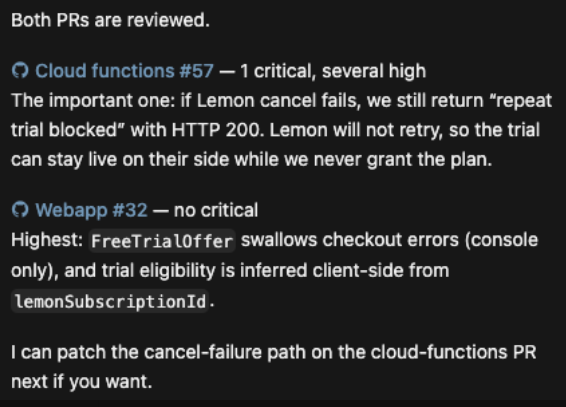
That last part matters for first-time founders. A critical finding that says “auth is broken” is useless if you cannot tell whether to panic. A finding that says “if cancel fails we still tell the user the trial is blocked, the payment provider will not retry, and the trial can stay live on their side” is something you can take back to the agent and fix.
ThinkReview already lives in the browser extension. The same review engine now lives inside the assistants that wrote the code, through ThinkReview MCP.
Review a PR in three words
Connect ThinkReview once in Cursor, GitHub Copilot, or Claude Code. Then you do not need a special slash command or a pasted diff. You can say:
thinkreview those PRs
Three words. The assistant finds the review_url_code tool, fetches the live pull request through your git credentials, and brings the review back into the same chat that opened the branch.
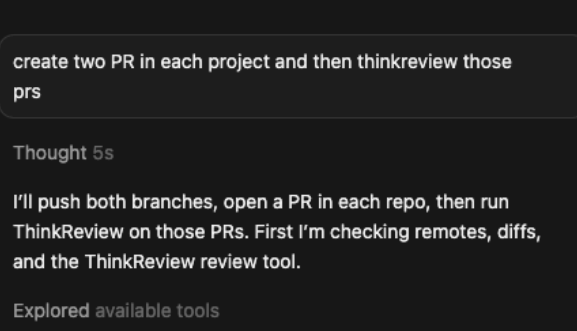
The output is not a vibe. It is a structured pass on the actual files: critical vs high, what will break in production, and what to patch next.
Setup is documented end to end — OAuth or Bearer, git integrations, Cursor / Copilot / Claude Code configs — on the MCP Integration docs page.
The moat is not the first deploy
AI made the first version cheap. That is why there are so many SaaS products this year, and why so many will be gone next year. The ones that last are not the ones that prompted the prettiest landing page. They are the ones that kept a review process after the novelty wore off.
If you are a founder who did not write the code, the merge request is how you stay in the loop. ThinkReview is how you read that merge request without pretending you can audit every line by hand.
Connect MCP from the portal setup page, add your git integrations, and run the next change through a PR. Then ask your assistant — in three words — to review it.
The boom is real. The review is what keeps the boom from becoming a refund queue. Install ThinkReview or connect MCP in the editor you already use.
Newsletter
Want the next one?
Leave your email and I’ll send the post when it’s published. Models, agents, and the review work in between. No drip after that.
One email when we publish. Unsubscribe in a click.